
Direct Answer
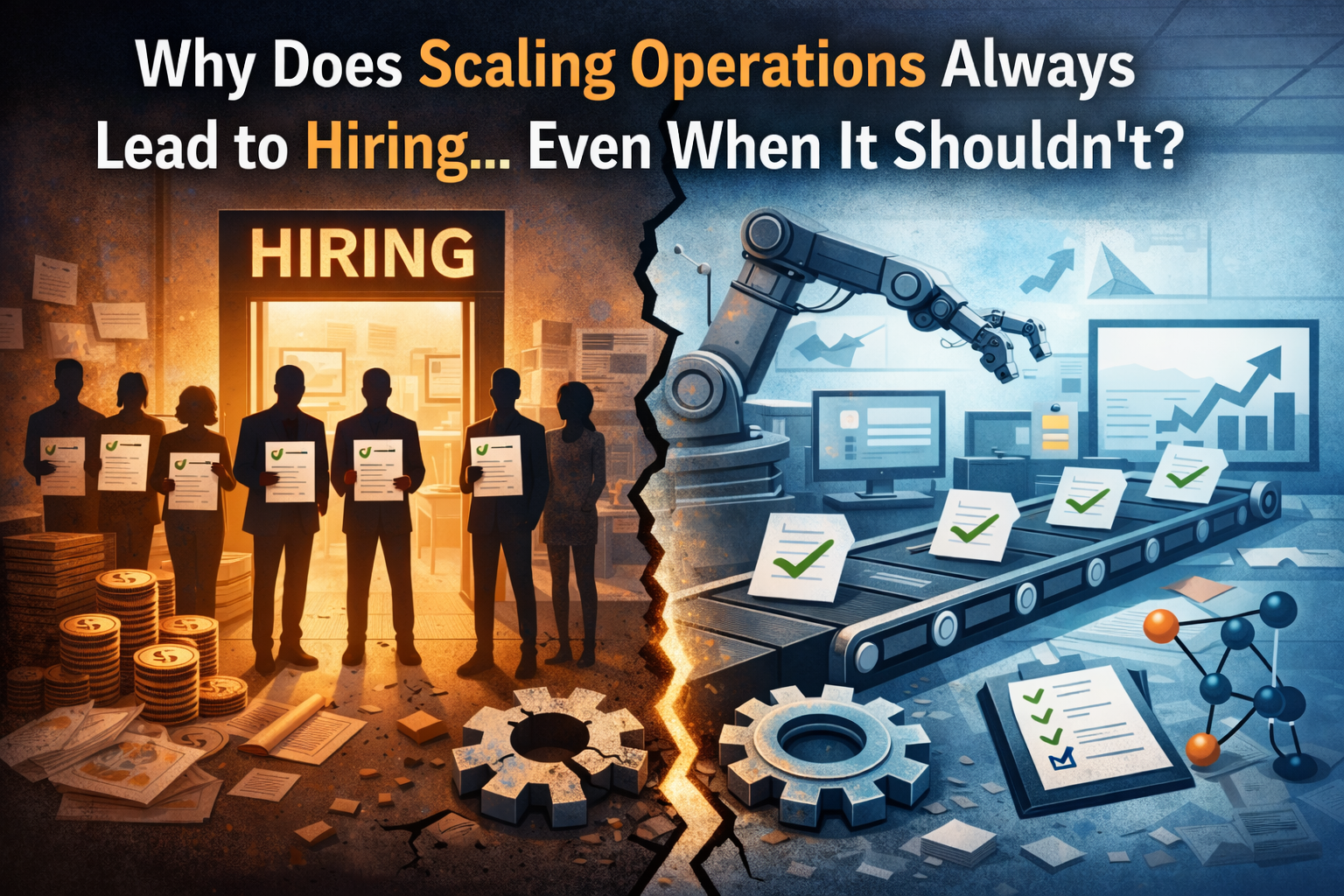
Most companies over-hire because they try to scale output with people instead of systems. The fix is to increase throughput per employee—using process standardization, automation, and tighter scope control—before adding headcount.
Quick Actionable Fix
Pick one core operational workflow (e.g., customer onboarding or order processing).
Document it step-by-step, remove unnecessary steps, and automate repetitive parts.
Then measure: how much output improves without adding people.
Key Insights
Headcount scales cost linearly; systems scale output non-linearly
Bottlenecks usually come from unclear processes, not lack of people
Early hiring hides inefficiencies instead of fixing them
Middle management becomes the silent cost of uncontrolled hiring
Tools alone don’t solve scaling—process clarity does
Deep Explanation (Systems + Patterns)
I’ve seen this pattern repeatedly: operations start breaking, teams feel overloaded, and the immediate response is hiring. On the surface, it makes sense—more work needs more hands.
But the real issue is usually hidden in the system.
Most operations evolve organically. Processes are undocumented, decisions are tribal, and execution depends on specific individuals. As volume increases, this fragility gets exposed. Work slows down, errors increase, and teams feel stretched.
Hiring becomes the default solution—not because it’s correct, but because it’s immediate.
The pattern repeats because:
It’s easier to add people than to redesign systems
Teams optimize for short-term relief, not long-term efficiency
Founders underestimate coordination overhead
At small scale, inefficiencies are tolerable. At larger scale, they compound.
Example:
A support team handling 50 tickets/day manually might feel fine. At 200 tickets/day, response times collapse. Hiring 3 more agents fixes it temporarily. But if ticket categorization, routing, and templates were automated, the same team could handle 200+ with minimal hiring.
Hype vs Reality
Hype:
“Hire fast to support growth.”
Reality:
Hiring amplifies whatever system already exists—good or bad.
If the system is inefficient, hiring scales inefficiency.
Business Implications (Cost, Scale, Risk)
Cost: Salaries, management layers, onboarding time, and operational overhead increase rapidly
Scale: Coordination complexity grows faster than output
Risk: Institutional knowledge fragments; dependency on individuals increases
At a certain point, each new hire adds less marginal value than the previous one.
Where It Breaks (Critical Section)
Internal teams hit limits when:
Processes are no longer clearly owned
Managers spend more time coordinating than executing
Training new hires slows down existing team productivity
Tools become fragmented across teams
Decision-making becomes inconsistent
This is where the assumption “we just need more people” starts failing.
Solving internally becomes expensive because:
Redesigning systems requires specialized thinking (ops design, automation, tooling)
Internal teams are already busy running day-to-day operations
The opportunity cost of slow execution becomes significant
This is the point where external execution—whether through specialized operators, automation partners, or outsourced workflows—becomes a logical extension, not a shortcut.
Common Mistakes or Misconceptions
Hiring before documenting processes
Assuming tools will fix broken workflows
Confusing activity (busy teams) with productivity
Ignoring coordination cost as team size grows
Believing every function must be built in-house
Practical Takeaway
Scale output per person first. If efficiency doesn’t improve, hiring will only multiply the problem—not solve it.
References
https://hbr.org/2014/05/why-fast-growth-can-kill-your-business
https://www.mckinsey.com/capabilities/operations/our-insights/the-operations-function-of-the-future
https://a16z.com/scaling-organizations/
https://www.gartner.com/en/articles/how-to-scale-without-adding-headcount
https://review.firstround.com/how-to-scale-without-killing-your-startup