
- Understanding the Causes of Back-and-Forth in Workflows
- Strategies to Streamline Communication and Minimize Back-and-Forth
- Balancing Automation and Human Oversight
- Addressing Organizational and Cultural Barriers
- Measuring Success and Continuous Improvement
Understanding the Causes of Back-and-Forth in Workflows
Excessive back-and-forth in workflows is primarily caused by systemic issues such as information asymmetry, undefined roles, manual repetitive tasks, disconnected systems, and lack of proactive process design. As highlighted in the research, "back-and-forth in workflows is primarily a symptom of systemic issues rooted in information asymmetry and loss, undefined roles and responsibilities, manual repetitive tasks, system silos and disconnected tools, and lack of proactive design" (nimblework.com).
These root causes manifest in practical ways:
- Incomplete or vague information during handoffs leading to clarifications and rework.
- Ambiguity in task ownership causing delays and task ping-pong.
- Manual data entry and approvals increasing errors and time consumption.
- Disparate systems requiring redundant data re-entry and fragmented progress tracking.
- Organic workflows without intentional efficiency design resulting in unnecessary steps.
Understanding these causes is critical for operations managers aiming to eliminate inefficiencies and reduce unnecessary delays in their processes.
Strategies to Streamline Communication and Minimize Back-and-Forth
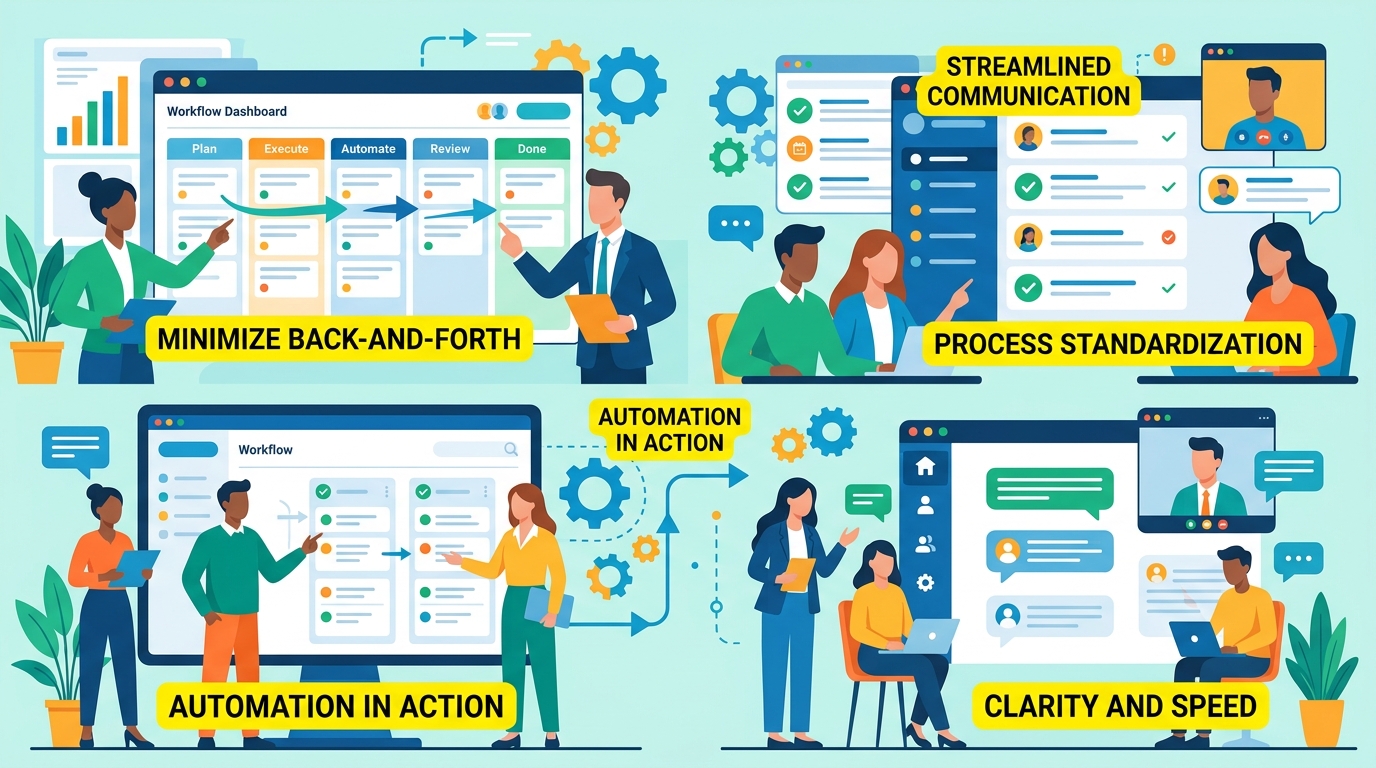
The fastest way to reduce back-and-forth is through rigorous process standardization, strategic automation, and clear communication protocols with explicit ownership at handoff points. The research emphasizes that "rigorous process standardization, strategic automation of repetitive tasks, and establishing explicit communication protocols with clear ownership at handoff points minimize ambiguity and eliminate unnecessary human intervention" (nutrient.io).
Key strategies include:
- Developing and documenting Standard Operating Procedures (SOPs), checklists, and playbooks to ensure consistency.
- Automating repetitive tasks such as data entry, approvals, notifications, and scheduling.
- Defining clear handoffs with checklists and standardized forms to ensure complete context transfer.
- Optimizing communication channels by consolidating tools and prioritizing relevant information.
- Implementing real-time visibility through KPIs and continuous feedback loops.
These approaches not only reduce delays but also improve overall operational quality, as seen in transportation-focused business process outsourcing services that optimize dispatching and customer support workflows effectively.
Balancing Automation and Human Oversight
While automation is a powerful tool to reduce back-and-forth, it must be balanced with human oversight to avoid embedding inefficiencies or losing flexibility. The research notes that "automation implementation requires substantial upfront investment and can embed existing inefficiencies if processes are poorly defined, while overly standardized processes risk reducing agility" (lean6sigmahub.com).
To balance these factors:
- Map and analyze workflows thoroughly before automating to ensure processes are optimized.
- Maintain flexibility in processes to adapt to changing business environments.
- Integrate automation tools with existing systems carefully to avoid tool sprawl and complexity.
- Invest in training and change management to ensure staff buy-in and compliance.
For example, in the ride-hailing industry, balancing automation with human intervention in driver onboarding and customer support improves efficiency without sacrificing service quality, as supported by specialized BPO services.
Addressing Organizational and Cultural Barriers
Reducing back-and-forth is not just a technical challenge but also an organizational and cultural one. The research highlights common mistakes such as neglecting the human element, underestimating training needs, and ignoring the root causes of inefficiency (kpifire.com).
To overcome these barriers:
- Engage employees in process redesign to increase ownership and reduce resistance.
- Provide comprehensive training and ongoing support for new workflows and tools.
- Focus on quality and clarity in communication rather than volume to reduce noise.
- Establish continuous improvement cultures that regularly review and refine workflows.
These cultural shifts are essential for sustaining long-term efficiency gains and avoiding the pitfalls of reverting to old habits.
Measuring Success and Continuous Improvement
Continuous measurement and improvement are vital to maintaining reduced back-and-forth in workflows. The research stresses the importance of "monitoring workflow performance with KPIs, identifying bottlenecks, and implementing continuous improvement cycles based on frontline feedback" (kpifire.com).
Effective measurement strategies include:
- Defining relevant KPIs such as cycle time, handoff delays, and error rates.
- Using real-time dashboards to monitor workflow health and identify emerging issues.
- Collecting feedback from frontline teams to understand practical challenges and opportunities.
- Regularly updating SOPs and training materials based on findings.
Organizations providing services like taxi dispatching and limo services BPO benefit greatly from these practices, ensuring scalable and resilient operations that adapt to fluctuating workloads and market demands.
For organizations looking to optimize their transportation operations, partnering with a specialized BPO provider like Fasttech BPO can help implement these strategies effectively, leveraging industry expertise and scalable support solutions.
Explore more about Taxi Dispatching BPO Services and Ride Hailing BPO Services to see how tailored outsourcing solutions reduce operational back-and-forth and improve efficiency.