
- Introduction
- Understanding Messy Workflows
- Steps to Transform Messy Workflows into Structured Systems
- Why Structure Enhances Operational Efficiency
- Common Pitfalls and How to Avoid Them
- Conclusion
Introduction
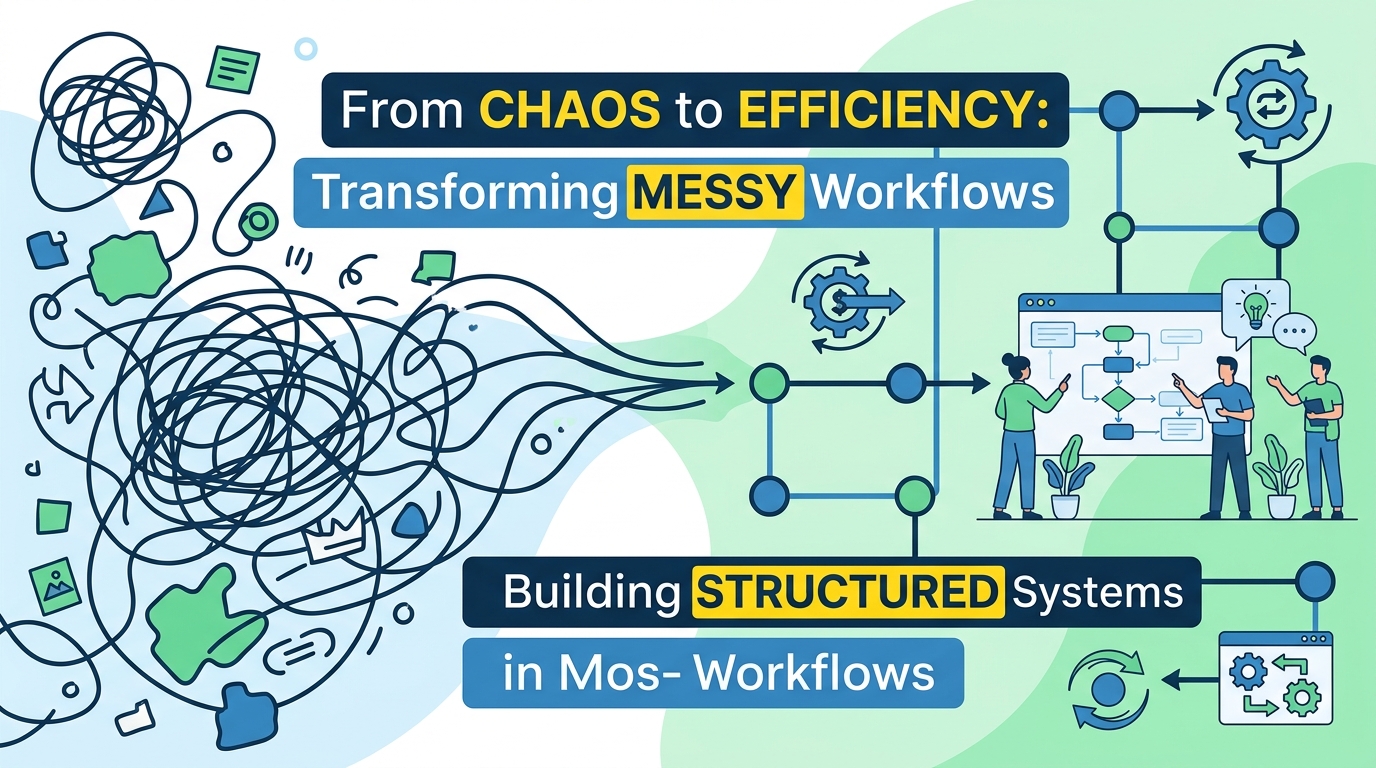
Transforming messy workflows into structured systems is essential for organizations seeking to improve operational efficiency, reduce costs, and mitigate risks. This transformation requires a disciplined approach that includes understanding current workflows, applying standardization and automation strategically, and prioritizing the human factors involved. As noted, "Structuring messy workflows involves meticulous process mapping, simplification, and selective automation, underpinned by robust data governance and continuous improvement."
This article explores the critical steps necessary to convert chaotic workflows into streamlined systems and how this structure enhances business operations. We will also highlight common challenges and practical strategies to overcome them.
Understanding Messy Workflows
Messy workflows often arise from organic growth where processes are developed ad-hoc to address immediate needs without foresight for scalability or integration. According to the research, such workflows suffer from "lack of foresight," "information silos," and an "over-reliance on manual labor and tribal knowledge," making them fragile and inefficient.
These root causes lead to fragmented data, slow processes, and resistance to change due to fear and perceived effort. Common characteristics of messy workflows include:
- Unstructured and redundant tasks relying heavily on manual intervention.
- Fragmented communication and data silos across departments.
- Processes built without standardization or documentation, increasing error rates and inconsistencies.
Steps to Transform Messy Workflows into Structured Systems
The first step in transforming workflows is comprehensive process mapping to identify every task, dependency, input, and output, exposing inefficiencies and bottlenecks. As emphasized, "Process Mapping as the Foundational Step" is critical for revealing hidden issues that impede performance.
Following mapping, simplification and standardization are essential. This involves eliminating unnecessary steps and documenting best practices through clear standard operating procedures (SOPs) and templates. Strategic automation is then applied selectively, starting with repetitive, high-frequency tasks to build momentum and allow adaptation.
- Conduct detailed process mapping to visualize current workflows.
- Eliminate redundant or unnecessary steps to simplify processes.
- Create standardized documentation and templates to ensure consistency.
- Implement phased automation focusing on repetitive tasks with clear ROI.
- Ensure data quality and system integration to support automation.
- Engage in change management and training to address human factors.
- Establish continuous improvement cycles for ongoing optimization.
For operations in transportation sectors such as ride-hailing or taxi dispatching, partnering with specialized BPO providers can enhance efficiency by applying these principles effectively. Services like Ride Hailing BPO Services and Taxi Dispatching BPO Services provide expert support in streamlining operations and managing complex workflows.
Why Structure Enhances Operational Efficiency
Structured workflows reduce operational costs, improve scalability, and mitigate risks by replacing manual, error-prone processes with consistent, repeatable systems. The research highlights that unstructured workflows lead to "increased operational costs through wasted time, redundant efforts, higher error rates," and difficulties in scaling operations effectively.
Benefits of structured workflows include:
- Cost savings from reduced redundancies and errors.
- Improved ability to scale without proportional increases in headcount.
- Enhanced compliance and risk management through standardized processes.
- Better data quality enabling accurate decision-making and automation.
- Higher employee satisfaction due to clarity and reduced frustration.
Industries that rely on real-time operations, such as limo services, benefit from structured systems that ensure premium customer experiences and operational reliability. Exploring Limo Services BPO Services can provide insights into how structured operations support high-touch service environments.
Common Pitfalls and How to Avoid Them
Many organizations stumble in workflow transformation by automating broken processes, neglecting data quality, or ignoring the human element. The research warns that "Automating a Broken Process" and "Focusing Solely on Technology, Ignoring People" are primary reasons for failure.
Key pitfalls include:
- Failing to address underlying process inefficiencies before automation.
- Assuming data cleanliness without dedicated governance.
- Resistance to change due to inadequate communication and training.
- Designing workflows only for ideal scenarios, neglecting exceptions and errors.
- Lack of ownership and continuous monitoring leading to stagnation.
A practical approach includes robust change management strategies and choosing the right technology solutions aligned with business needs, whether building custom platforms, buying off-the-shelf, or adopting hybrid solutions. This balanced approach ensures sustainable workflow improvements.
Conclusion
Turning messy workflows into structured systems is a strategic imperative for businesses aiming to enhance operational efficiency, scale effectively, and reduce risk. Success depends on careful process mapping, simplification, selective automation, and prioritizing the human element through change management. Continuous improvement must be embedded to adapt workflows to evolving needs.
Transportation operators can leverage specialized BPO services such as those offered by Fasttech BPO to implement these best practices and achieve reliable, scalable operations. For more insights on optimizing transport operations, visit the Industries overview page to explore how structured systems drive success across sectors.