
Direct Answer
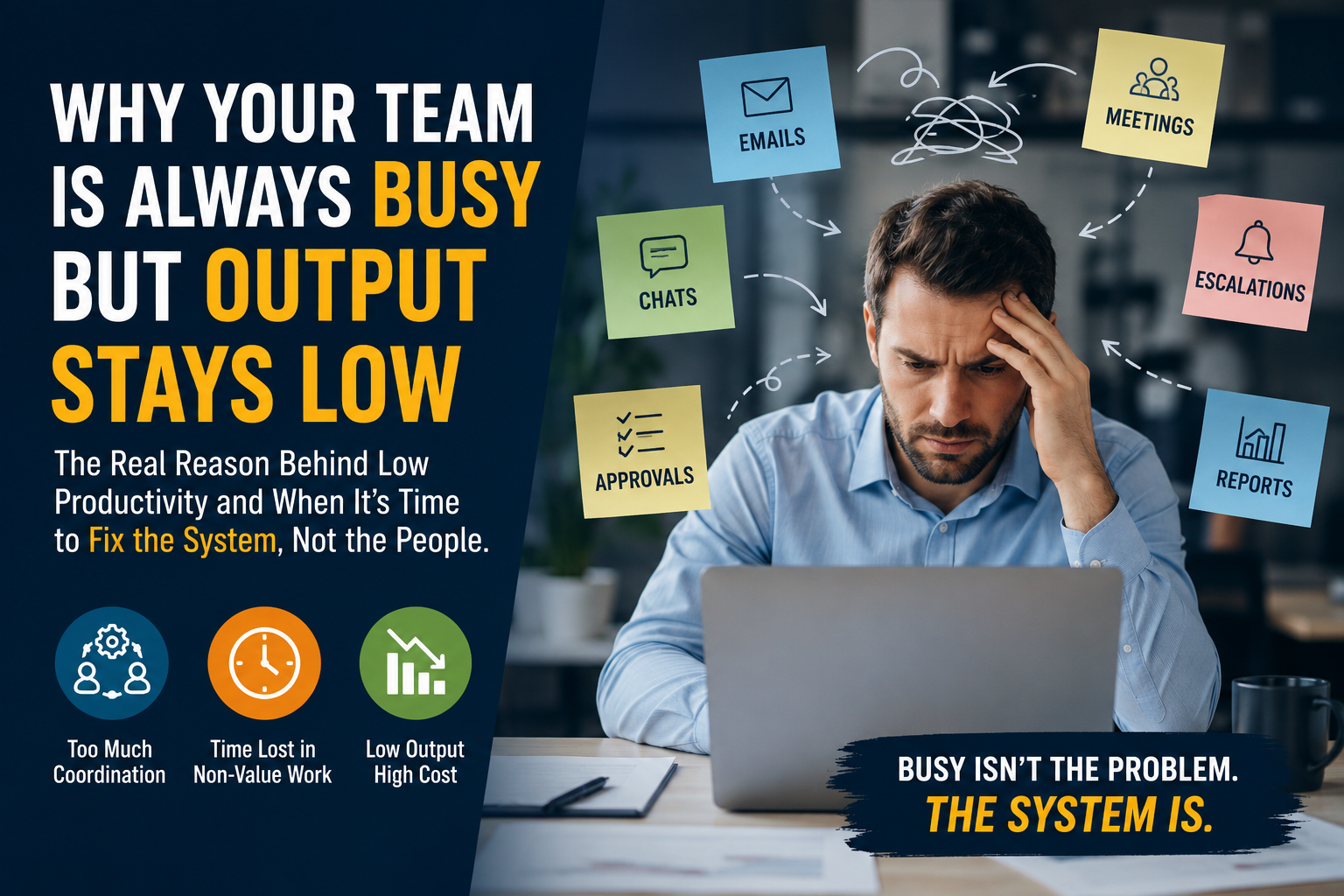
Most teams are not overloaded with work. They are overloaded with coordination.
That is the real reason output stays low even when everyone looks busy.
The problem usually is not effort. It is fragmented workflows, constant interruptions, unclear ownership, and systems that force people to spend more time managing work than actually doing it.
A simple fix: track where time goes for one week using only three categories:
Revenue-generating work
Operational maintenance
Internal coordination
Most companies discover that coordination consumes more time than execution.
That is the bottleneck.
Key Insights
Busy teams often spend more time switching tasks than completing them
Operational chaos increases as communication tools and approvals increase
Most workflow problems are system failures, not employee failures
Hiring more people usually increases coordination overhead
Manual processes create “shadow work” that leadership rarely sees
Internal fixes work initially, but complexity eventually outgrows them
Outsourcing becomes valuable when operational maintenance starts consuming strategic capacity
Deep Explanation
The biggest misconception in operations is believing activity equals productivity.
It does not.
A team replying to emails all day, joining meetings, updating dashboards, and handling escalations can appear highly productive while creating very little meaningful output.
This happens because modern operations are full of invisible work.
Researchers now describe this as “digital debt” — the accumulation of interruptions, coordination tasks, approvals, and fragmented communication that slowly consumes operational capacity. Studies show knowledge workers are interrupted roughly every two minutes, while a significant portion of work hours is spent on coordination instead of creation.
The pattern repeats in almost every growing business.
At first, operations run on speed and improvisation.
Small teams communicate quickly.
Founders solve problems directly.
Everyone knows what is happening.
Then growth happens.
More customers.
More tickets.
More staff.
More tools.
More handoffs.
Now the same workflows that once worked become operational friction.
One support issue touches three departments.
One refund requires four approvals.
One customer escalation creates ten Slack messages.
The business becomes operationally “busy” without becoming operationally efficient.
This is why many companies feel slower after hiring more people.
More people create more coordination layers.
Why This Keeps Repeating
Most businesses optimize for responsiveness instead of system clarity.
So they add:
More meetings
More managers
More approvals
More software
More reporting
Initially, this creates control.
Eventually, it creates operational drag.
Lean operations frameworks classify this as non-value-added work — activities consuming resources without directly improving customer outcomes.
The dangerous part is that this waste rarely looks obvious.
It looks like:
“Quick sync calls”
“Urgent follow-ups”
“Internal alignment”
“Temporary workarounds”
But repeated at scale, these become permanent operational costs.
This is where many businesses enter reactive mode.
The company spends its time responding instead of improving.
Business Implications
When output stays flat while workload increases, businesses usually experience the same operational symptoms:
Support backlog grows
Response times slow down
Managers become bottlenecks
Employees depend on tribal knowledge
Quality becomes inconsistent
Founders get trapped in operations
Payroll increases faster than productivity
The financial impact compounds quietly.
Manual tracking errors alone cost businesses thousands annually, while fragmented workflows increase rework, delays, and operational leakage.
This becomes especially visible in high-volume operations.
For example:
Customer support queues become unpredictable
Dispatch operations slow during peak demand
Refund handling creates repeated back-and-forth
Teams spend more time escalating than resolving
The workload increases faster than the internal system’s ability to absorb complexity.
Where It Breaks
Internal systems usually work… until volume increases.
That is the important distinction.
A team can manage chaos manually at:
50 tickets per day
10 employees
One communication channel
One location
But operations change completely at:
500+ daily tickets
Multi-shift coverage
Multiple departments
Multi-channel support
Real-time coordination requirements
At this point, the problem stops being “team performance.”
It becomes an execution-capacity problem.
This is where many businesses make the wrong move:
They hire more people into broken systems.
That increases communication load even further.
The result:
more management overhead, more inconsistencies, and more operational firefighting.
Eventually, leadership realizes something important:
Not every operational layer needs to stay internal.
Especially repetitive, process-driven work.
This is why mature operators begin separating:
Strategic decision-making
fromOperational execution
The goal is not replacing strategy.
The goal is reducing operational drag.
Common Mistakes
1. Treating Busy Employees as Productive Employees
High activity often hides inefficient workflows.
2. Adding More Tools Instead of Simplifying Systems
Software cannot fix unclear ownership.
3. Measuring Time Instead of Output
Hours worked rarely explain operational effectiveness.
4. Keeping Everything Internal
Some operational layers become too expensive to maintain in-house at scale.
5. Ignoring “Necessary Waste”
Compliance, QA, escalations, and support coordination are unavoidable.
The goal is optimization, not elimination.
Practical Takeaway
If your team constantly feels overwhelmed while output remains flat, start with one operational audit question:
“What percentage of our day goes toward execution versus coordination?”
That single metric reveals more than most dashboards.
Then:
Identify repetitive operational work
Standardize the workflow
Remove unnecessary approvals
Reduce communication layers
Separate strategic work from process-heavy execution
This works extremely well early on.
But once operational complexity reaches a certain point, internal optimization alone stops producing meaningful gains.
That is usually the moment businesses stop asking:
“How do we make people work harder?”
And start asking:
“How do we build systems that scale without consuming leadership capacity?”
That shift changes everything.
References
Lean Enterprise Institute — Lean Management Principles
https://www.lean.orgHarvard Business Review — Collaborative Overload
https://hbr.org/2016/01/collaborative-overloadMicrosoft Work Trend Index — Digital Debt and Workplace Productivity
https://www.microsoft.com/en-us/worklab/work-trend-indexBureau of Labor Statistics — Employer Costs for Employee Compensation
https://www.bls.gov/news.release/ecec.nr0.htmMcKinsey & Company — The State of Organizations
https://www.mckinsey.com/capabilities/people-and-organizational-performance/our-insights/the-state-of-organizationsAsana Anatomy of Work Index
https://asana.com/resources/anatomy-of-workAtlassian — Cost of Context Switching Research
https://www.atlassian.com/blog/productivity/context-switchingGartner — Future of Work Trends
https://www.gartner.com/en/human-resources/topics/future-of-work