
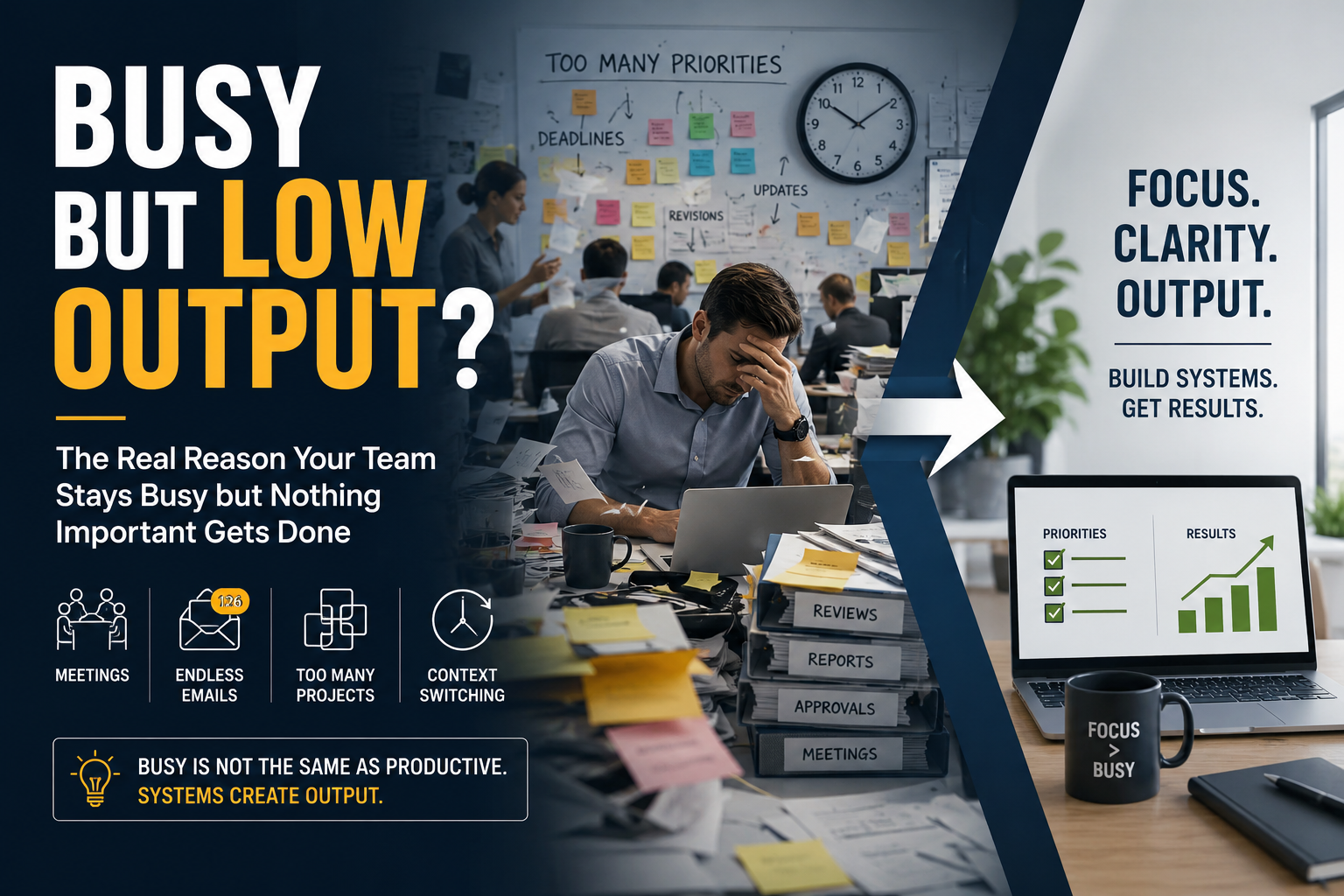
Direct Answer
I rarely see low output caused by lazy teams.
Most of the time, the system itself is overloaded.
Too many active projects, too many approvals, too many meetings, and too much context switching create an environment where people stay busy but very little actually gets completed.
The fastest operational fix is usually simple:
Reduce active priorities, limit parallel work, and clarify ownership before adding more people, tools, or processes.
Key Insights
Busy teams are often suffering from coordination overload, not lack of effort
More projects usually reduce throughput instead of increasing it
Meetings scale communication — until they start replacing execution
Full utilization looks efficient on dashboards but creates delivery bottlenecks
Most companies optimize for responsiveness instead of completed outcomes
New tools and AI rarely solve operational chaos without workflow simplification first
Internal teams often become the “middleware” between disconnected systems and unclear decisions
The Real Problem Is Usually Structural
Most businesses assume output problems are performance problems.
In practice, they are usually flow problems.
The moment a company grows, complexity grows faster than leadership expects:
more clients
more approvals
more tools
more stakeholders
more reporting
more dependencies
At first, this feels manageable.
Then something subtle happens:
the organization slowly shifts from doing work to managing work.
That shift is where productivity quietly collapses.
A Quick Fix Most Teams Can Apply Immediately
Before redesigning operations, hiring consultants, or buying software:
Do this first:
Freeze new initiatives for 2 weeks
List every active project
Kill or pause 30–50% of them
Assign one clear owner per remaining initiative
Remove recurring meetings that do not directly unblock delivery
Force teams to finish before starting new work
This usually exposes the real bottleneck within days.
Not because the team suddenly works harder —
but because work stops competing against itself.
Why This Keeps Repeating in Businesses
The pattern is extremely common because most organizations reward activity visibility, not operational throughput.
People get rewarded for:
replying quickly
attending meetings
managing urgency
multitasking
staying available
looking overloaded
Very few companies reward:
reducing work in progress
eliminating unnecessary coordination
simplifying systems
protecting deep execution time
So the organization slowly trains itself into performative productivity.
Everyone looks occupied.
Very little moves forward cleanly.
The Hidden Cost of “Keeping Everyone Busy”
This is where theory and practice separate sharply.
In Theory
Keeping employees fully utilized sounds efficient.
If everyone is busy:
payroll appears optimized
specialists stay occupied
resources appear fully leveraged
In Practice
Full utilization creates:
queue buildup
slower delivery
dependency bottlenecks
constant interruptions
fragmented ownership
rising management overhead
A designer working across six projects is not operating at 100% productivity.
They are operating inside six different switching costs.
The same applies to:
developers
operations managers
analysts
compliance teams
leadership
At scale, context switching becomes an invisible tax on throughput.
Why Meetings Eventually Become Operational Debt
Meetings are useful.
But only up to a point.
As organizations scale, meetings become a substitute for clarity.
Instead of fixing:
unclear ownership
bad workflows
missing documentation
weak systems
companies add:
sync calls
standups
alignment meetings
status reviews
escalation calls
The result is predictable:
execution time gets consumed by coordination time.
This is why many teams feel exhausted despite producing very little measurable output.
The Pattern Most Leadership Teams Miss
Operational drag rarely appears all at once.
It accumulates slowly through “reasonable” decisions.
Examples:
Scenario 1 — Product Team
A company launches:
12 initiatives simultaneously
shared engineers across teams
weekly stakeholder reviews
multiple approval layers
Everything looks active.
But every project now depends on:
shared resources
scheduling coordination
executive availability
cross-team synchronization
The organization increased activity.
It reduced throughput.
Scenario 2 — Operations Team
An operations department tries reducing mistakes by adding:
more trackers
more approvals
more reporting
more meetings
Initially, risk decreases.
Later:
cycle times slow
accountability weakens
duplication increases
decision latency rises
The company becomes operationally safer —
but commercially slower.
Where Internal Systems Start Breaking
This is the point most businesses underestimate.
Internal execution works well until complexity exceeds coordination capacity.
That threshold depends on:
number of active initiatives
management maturity
process quality
leadership clarity
tooling integration
cross-functional dependency load
Once complexity crosses that threshold, internal teams start spending most of their energy maintaining the system instead of producing outcomes.
That is usually when:
deadlines slip repeatedly
managers become permanent firefighters
teams lose strategic focus
hiring no longer improves output proportionally
At this stage, adding more employees often increases operational drag instead of solving it.
Why More Tools Usually Don’t Fix the Problem
This is another major misconception.
Companies often respond to operational chaos by adding:
project management software
dashboards
automations
AI tools
reporting layers
But tools amplify systems.
They do not fix broken ones.
If priorities are unstable and workflows are fragmented:
automation scales confusion
dashboards increase noise
AI accelerates low-value work
Technology works best after operational simplification —
not before it.
The Real Limitation of Internal Teams
Internal teams usually fail to fix these problems for one reason:
The same people causing the coordination overload are also responsible for solving it.
That creates a structural conflict.
Leadership asks overloaded teams to:
redesign workflows
improve productivity
maintain delivery
run change initiatives simultaneously
In reality, transformation work requires protected execution capacity.
Most companies do not have that internally.
That is the point where external execution starts becoming logical — not because internal teams are weak, but because the operating system itself is saturated.
Where Outsourcing or External Execution Starts Making Sense
External support becomes valuable when the business needs:
operational redesign
process simplification
workflow consolidation
systems integration
execution bandwidth
neutral prioritization
temporary specialized capacity
Not every business needs outsourcing.
But many businesses reach a stage where internal coordination costs become more expensive than external execution support.
That is an operational decision —
not a staffing decision.
Common Mistakes
Mistaking busyness for productivity
High activity does not equal high throughput.
Starting too much work simultaneously
More active projects usually create slower delivery across all projects.
Using meetings to compensate for weak systems
Meetings should support execution, not replace clarity.
Measuring responsiveness instead of outcomes
Fast replies are not the same as finished work.
Adding software before simplifying workflows
Technology magnifies operational design — good or bad.
Expecting overloaded managers to redesign the organization
Transformation requires dedicated capacity.
Business Implications
If this problem continues unchecked, the business eventually experiences:
rising labor cost without matching output
slower product delivery
leadership burnout
operational inconsistency
customer frustration
declining margins
scaling difficulty
The dangerous part is that many companies do not notice the issue early because effort levels remain high.
Everyone feels busy.
So leadership assumes progress is happening.
Operationally, that assumption is often wrong.
Practical Takeaway
Busy teams are not always productive teams.
When work keeps expanding but outcomes stay flat, the problem is usually not talent — it is system overload.
Reducing complexity works.
But only up to a point.
After that, businesses either redesign execution capacity internally —
or bring in external support to restore operational flow.
References
Asana — Anatomy of Work
https://asana.com/resources/why-work-about-work-is-badAtlassian — State of Teams Report
https://www.atlassian.com/blog/state-of-teams-2024Atlassian — Work In Progress Limits
https://www.atlassian.com/agile/kanban/wip-limitsMcKinsey — Rethinking Productivity
https://www.mckinsey.com/capabilities/people-and-organizational-performance/our-insights/want-to-break-the-productivity-ceiling-rethink-the-way-work-gets-doneMcKinsey — Decision-Making Structures
https://www.mckinsey.com/capabilities/people-and-organizational-performance/our-insights/the-organization-blog/the-limits-of-raci-and-a-better-way-to-make-decisionsMicrosoft Work Trend Index
https://www.microsoft.com/en-us/worklab/work-trend-index/2025-the-year-the-frontier-firm-is-bornDORA State of DevOps Report
https://dora.dev/research/2024/dora-report/Harvard Business Review — The Overcommitted Organization
https://www.harvardbusiness.org/wp-content/uploads/2020/03/HBR_The_Overcommitted_Organization.pdfBusiness Horizons — Meeting Load Research
https://www.sciencedirect.com/science/article/pii/S0007681323001167
Tags
Business Operations, Team Productivity, Operational Efficiency, Workflow Management, Scaling Businesses, Leadership, Process Optimization, Organizational Design, Team Management, Outsourcing, Systems Thinking, Operational Strategy, Productivity Systems, Execution Management, Business Growth