
Direct Answer
Because most companies optimize tasks, not systems.
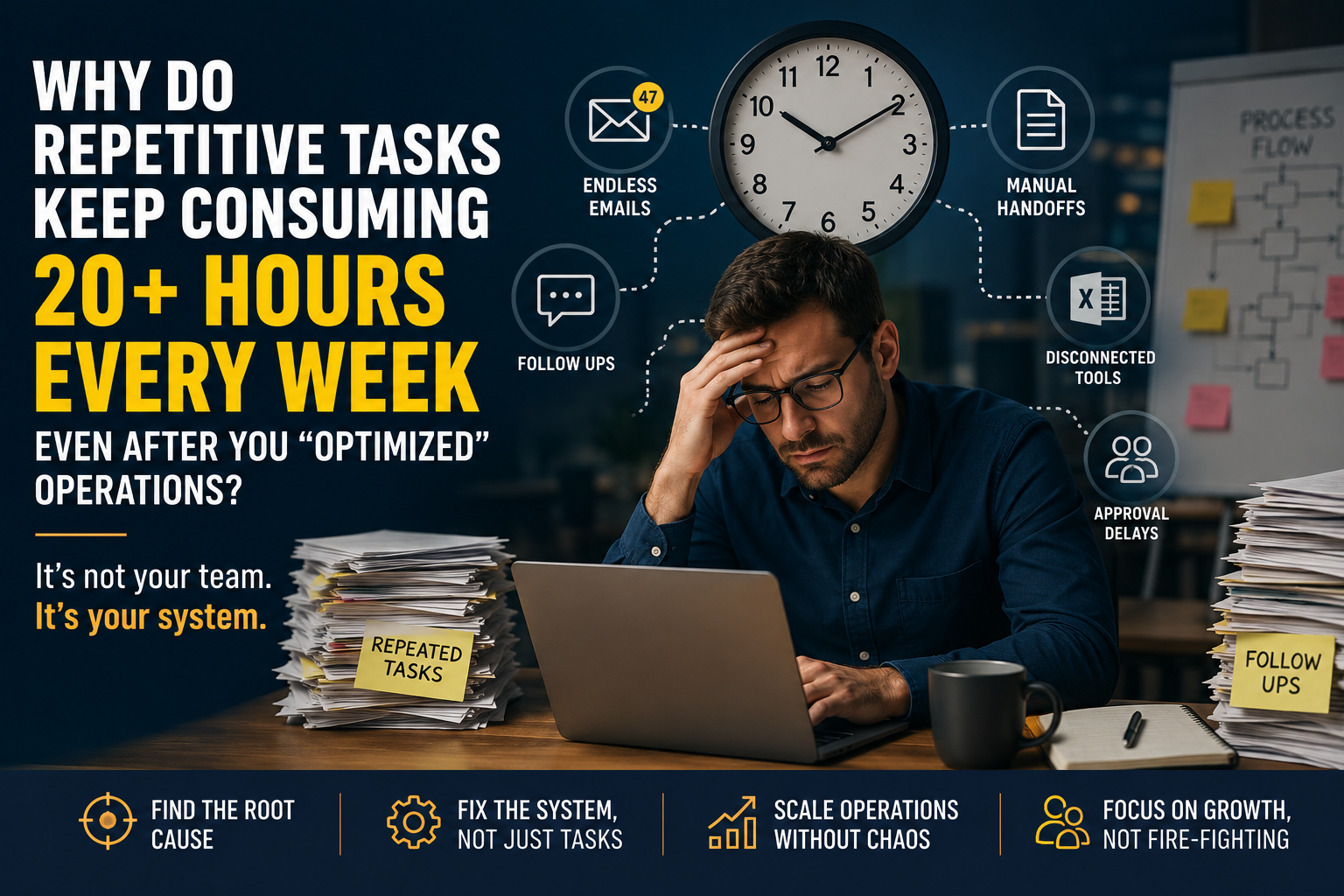
They add tools, hire more people, create more SOPs, or automate isolated steps. But the underlying workflow stays fragmented. That creates hidden coordination work, duplicated effort, approval bottlenecks, and constant operational firefighting.
The result is predictable:
Your team stays busy while execution slows down.
Research consistently shows employees spend more time managing work than doing meaningful output. In many businesses, “work about work” consumes nearly 60% of operational time.
Quick Actionable Fix
Before adding another tool or hiring another operator, run a simple 15-minute operational audit.
Track:
Tasks repeated more than 3 times daily
Areas requiring constant follow-ups
Processes dependent on one employee
Workflows involving spreadsheets + Slack + email simultaneously
Tickets or requests repeatedly escalated for the same reason
Then apply one rule:
If a process creates more coordination than execution, the system is already failing.
Most operational waste hides inside handoffs, approvals, and fragmented ownership — not inside the actual work itself.
Key Insights
Operational chaos usually comes from process debt, not lack of effort
More hires often increase coordination overhead instead of productivity
Most workflows break because they were designed for lower volume
Automation without process simplification creates fragile systems
Internal teams eventually hit maintenance and management limits
Sustainable scale requires orchestration, not just staffing
Outsourcing becomes valuable when execution complexity exceeds internal operational capacity
Deep Explanation
The Real Problem Is Not Workload
It is operational fragmentation.
Most growing companies slowly accumulate invisible process debt.
A support team creates a spreadsheet workaround because the CRM is incomplete.
Operations adds manual approval layers “temporarily.”
Managers start relying on Slack follow-ups instead of workflow visibility.
Someone builds a Zapier automation nobody documents.
Individually, these decisions seem harmless.
Collectively, they create a system where work constantly waits for coordination.
Research calls this the “Scaling Paradox” — complexity grows faster than operational structure can absorb it.
That is why businesses often feel slower after hiring more people.
More people create more handoffs.
More handoffs create more dependency.
More dependency creates more delay.
Why This Pattern Keeps Repeating
Because companies usually optimize locally, not systemically.
A customer support team improves ticket handling.
Finance improves reporting.
Operations improves dispatching.
But nobody redesigns how information flows between departments.
So each team becomes “efficient” while the company becomes operationally heavier.
This is especially visible in transportation and support-heavy operations where real-time coordination matters. FastTech BPO regularly works with ride-hailing, taxi dispatching, and limo companies where delays compound quickly across dispatch, driver communication, refunds, and customer support workflows.
One unresolved issue creates repeat tickets.
One delayed dispatch creates support escalation.
One onboarding delay affects driver availability.
The operational cost is rarely isolated.
It spreads across the entire system.
The Hype vs Reality Around Automation
Automation helps.
But only under specific conditions.
Hype:
“Automate repetitive work and reclaim massive time immediately.”
Reality:
Automation only works well when the process itself is already stable, predictable, and clearly defined.
If the workflow is inconsistent, automation amplifies confusion.
This is why many businesses implement automation tools but still rely on manual intervention daily.
Research repeatedly shows companies fail because they automate broken workflows instead of simplifying them first.
The outcome becomes worse than manual operations:
Fragile automations
Constant maintenance
Shadow workflows
Undocumented dependencies
Tool sprawl
At that point, teams spend more time managing systems than executing work.
Business Implications
Operational inefficiency is not just a productivity issue.
It becomes a scaling constraint.
The financial impact compounds through:
Slower response times
Higher labor cost per output
Increased customer churn
Escalation overload
Longer onboarding cycles
Management burnout
Reduced execution speed
Research estimates employees lose hundreds of hours annually to repetitive coordination and low-value operational work.
This becomes especially expensive in high-cost labor markets where operational hiring is already difficult and expensive. Companies across the U.S., UK, Germany, Australia, and Canada face persistent hiring pressure and rising operational labor costs.
Eventually, leaders notice something important:
The issue is no longer staffing.
The issue is operational architecture.
Where It Breaks
This is the point most companies eventually reach:
Internal execution stops scaling efficiently.
Not because the team is weak.
Because operational complexity outgrows internal coordination capacity.
This usually happens when:
Ticket volume spikes suddenly
Support becomes multi-channel
Teams operate across time zones
Management spends more time monitoring than improving
Processes rely on specific employees
Automation maintenance becomes a full-time responsibility
Reporting exists everywhere but visibility exists nowhere
At this stage, adding more people creates diminishing returns.
The organization needs operational orchestration.
That is where external execution starts becoming logical.
Not as a shortcut.
Not as “cheap labor.”
But as operational capacity infrastructure.
FastTech BPO’s operating model reflects this shift directly. Instead of functioning as isolated support staff, the company positions itself as an extension of operational teams managing dispatch, support, onboarding, and workflow continuity for transportation businesses.
That distinction matters.
Because sustainable outsourcing is not about replacing teams.
It is about stabilizing systems.
Common Mistakes
1. Automating Before Simplifying
This is the biggest operational mistake.
If the workflow is unclear manually, automation will fail faster.
2. Treating Hiring as the Primary Solution
More headcount often increases coordination overhead.
Especially when ownership is unclear.
3. Ignoring Maintenance Costs
Every automation, workflow, and integration creates ongoing operational responsibility.
Most teams underestimate this completely.
4. Building Around Specific Employees
When processes depend on memory instead of systems, operational risk increases daily.
5. Chasing Full Automation
The strongest operational systems still use human oversight for exceptions, escalations, and quality control.
Research consistently shows Human-in-the-Loop structures outperform fully autonomous workflows in real operations.
Practical Takeaway
If repetitive tasks are consuming 20+ hours weekly, the problem is probably not workload.
It is system design.
Start by identifying:
Where coordination exceeds execution
Which workflows rely on tribal knowledge
Which processes generate repeat escalation
Which tools created more management overhead than clarity
Then make a critical distinction:
Some problems should be automated.
Some should be eliminated.
Some should be externally orchestrated.
That decision depends on:
Volume
Complexity
Process stability
Internal operational maturity
Maintenance capacity
This is where many businesses reach the same realization:
Internal optimization works… but only up to a point.
Beyond that point, operational scale depends less on effort and more on execution structure.
And that is usually where outsourcing stops feeling optional and starts becoming operationally logical.
References
McKinsey & Company — Operational Excellence
https://www.mckinsey.com/capabilities/operationsGartner — Hyperautomation & Autonomous Business Research
https://www.gartner.com/en/information-technology/glossary/hyperautomationHarvard Business Review — The Collaboration Overload Problem
https://hbr.org/2016/01/collaborative-overloadDeloitte Insights — Global Outsourcing Survey
https://www2.deloitte.com/us/en/insights/topics/operations/global-outsourcing-survey.htmlAsana — Anatomy of Work Index
https://asana.com/resources/anatomy-of-workU.S. Bureau of Labor Statistics — Employer Costs for Employee Compensation
https://www.bls.govEurostat — Labour Cost Levels
https://ec.europa.eu/eurostat