
- Common Sources of Workflow Confusion Between Departments
- Strategies to Fix Workflow Confusion
- Role of Leadership and Culture in Resolving Confusion
- Technology and Tools to Enhance Interdepartmental Workflow
- Measuring Success and Continuous Improvement
Common Sources of Workflow Confusion Between Departments
Workflow confusion between departments often arises from structural and cultural issues within an organization. As identified in the research, siloed operations, lack of transparency, and poor or undefined communication channels are primary contributors to confusion and inefficiency. Departments tend to prioritize local goals over enterprise objectives, leading to duplicated efforts and fragmented information flow, which exacerbates misunderstandings and delays in decision-making (resolution.de).
Additional root causes include conflicting goals and misaligned incentives, undefined roles and decision-making authority, reliance on manual or outdated workflows, and a lack of mutual trust and empathy between teams. These factors collectively contribute to operational risk, inefficiency, and increased costs.
- Siloed operations and lack of transparency
- Poor or undefined communication channels
- Conflicting goals and misaligned incentives
- Undefined roles and decision-making authority
- Outdated workflows and legacy systems
- Lack of trust and empathy
For operations managers, understanding these common sources is a crucial first step toward implementing targeted solutions that address the root causes rather than just symptoms.
Strategies to Fix Workflow Confusion
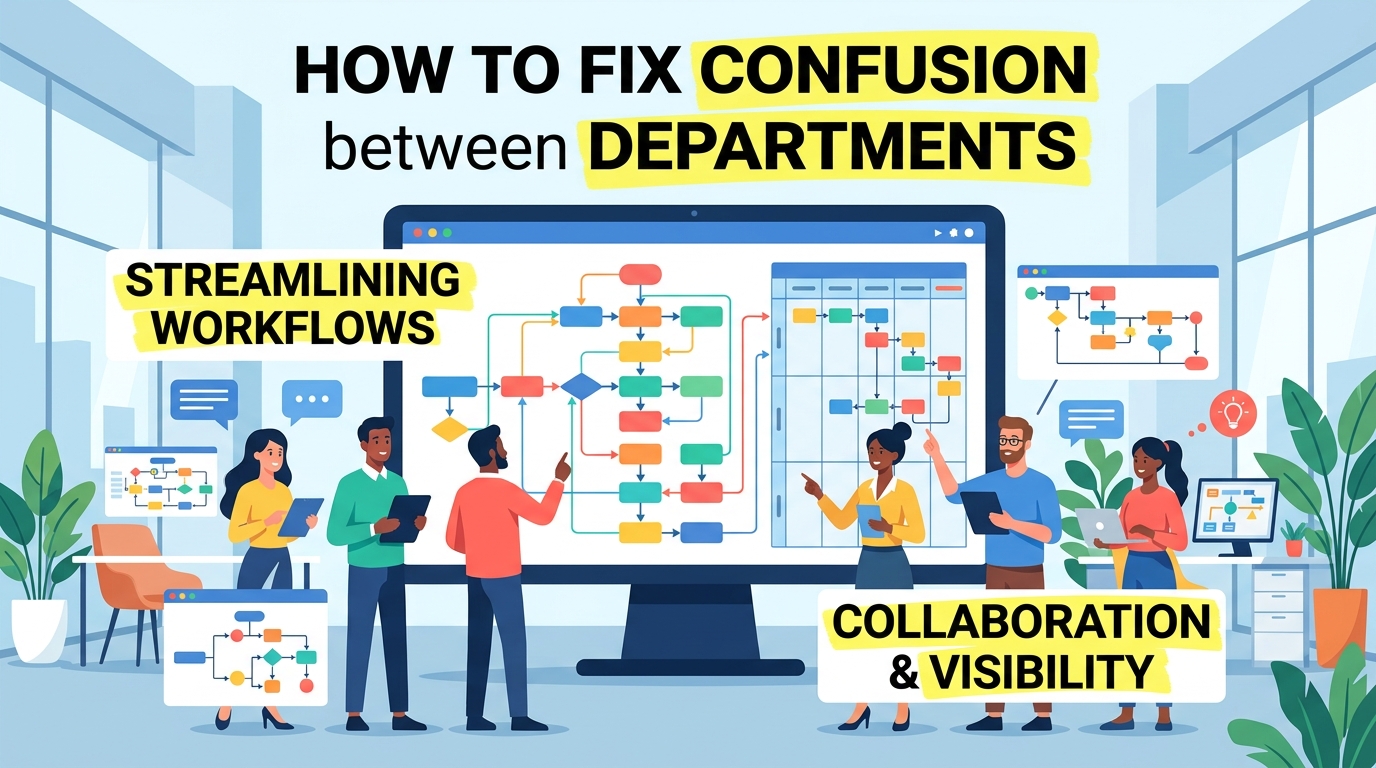
Fixing workflow confusion requires a systematic approach emphasizing transparency, accountability, and communication integration. Organizations that succeed often employ process mapping and standardization to visually clarify workflow sequences and handoff points. Frameworks such as RAPID or DACI help define roles, responsibilities, and decision-making authority, preventing ambiguity (kpifire.com).
Key strategies include:
- Visual process mapping using swimlane diagrams or SIPOC charts
- Explicitly defining roles and decision rights with frameworks like RAPID or DACI
- Centralizing communication through single sources of truth and dedicated collaboration platforms
- Aligning departmental KPIs with organizational goals to reduce conflicting priorities
- Fostering a culture of open communication, empathy, and trust
- Leveraging technology and workflow automation strategically
Implementing these strategies helps reduce bottlenecks, improve handoffs, and build a shared understanding across teams, which is essential for smooth operations in industries such as ride-hailing and taxi dispatching (Ride Hailing BPO Services, Taxi Dispatching BPO Services).
Role of Leadership and Culture in Resolving Confusion
Leadership commitment is indispensable in resolving workflow confusion between departments. Leaders set the tone for transparency, accountability, and collaboration, which are foundational for successful workflow redesign. The research emphasizes that without visible and consistent leadership support, initiatives often fail due to lack of perceived importance and resource allocation (redbricklabs.io).
Creating a culture of collaboration and empathy encourages open dialogue and mutual understanding of interdepartmental challenges, which reduces friction and builds trust. Leadership should also prioritize continuous improvement, recognizing that workflow optimization is an ongoing process rather than a one-time fix.
- Visible and active leadership involvement
- Promoting a culture of trust, openness, and empathy
- Encouraging continuous process review and adaptation
- Providing resources and training for change management
Such cultural shifts are vital in industries requiring seamless coordination, like limo services where premium customer experience depends on flawless interdepartmental workflows (Limo Services BPO Services).
Technology and Tools to Enhance Interdepartmental Workflow
Technology plays a strategic role in connecting departments and streamlining workflows, but it is not a standalone solution. Effective use of integrated collaboration platforms, centralized information hubs, and workflow automation tools can reduce manual effort and improve real-time communication. However, organizations must avoid tool sprawl and ensure technology adoption is aligned with clear process definitions (brewsterconsulting.io).
Technology benefits include:
- Centralized project documentation and communication
- Real-time updates and asynchronous collaboration
- Workflow automation to reduce repetitive manual tasks
- Integration of disparate legacy systems for seamless data flow
- Data-driven decision-making support through dashboards and analytics
For transportation companies, leveraging technology effectively can enhance daily operations and customer support, as seen in ride-hailing and taxi dispatching sectors (Ride Hailing BPO Services, Taxi Dispatching BPO Services).
Measuring Success and Continuous Improvement
To sustain improvements and prevent workflow confusion from recurring, organizations must establish clear metrics and feedback loops. Aligning KPIs across departments with organizational goals ensures that workflow changes contribute to strategic objectives. Continuous monitoring, root cause analysis, and iterative refinements are essential to adapt workflows to evolving business needs (kpifire.com).
Key practices include:
- Defining shared KPIs that reflect cross-departmental outcomes
- Implementing regular workflow audits and performance reviews
- Establishing communication protocols for feedback and issue escalation
- Encouraging employee involvement in process improvements
Organizations that embrace continuous improvement maintain operational resilience and are better positioned to scale efficiently in dynamic markets.