
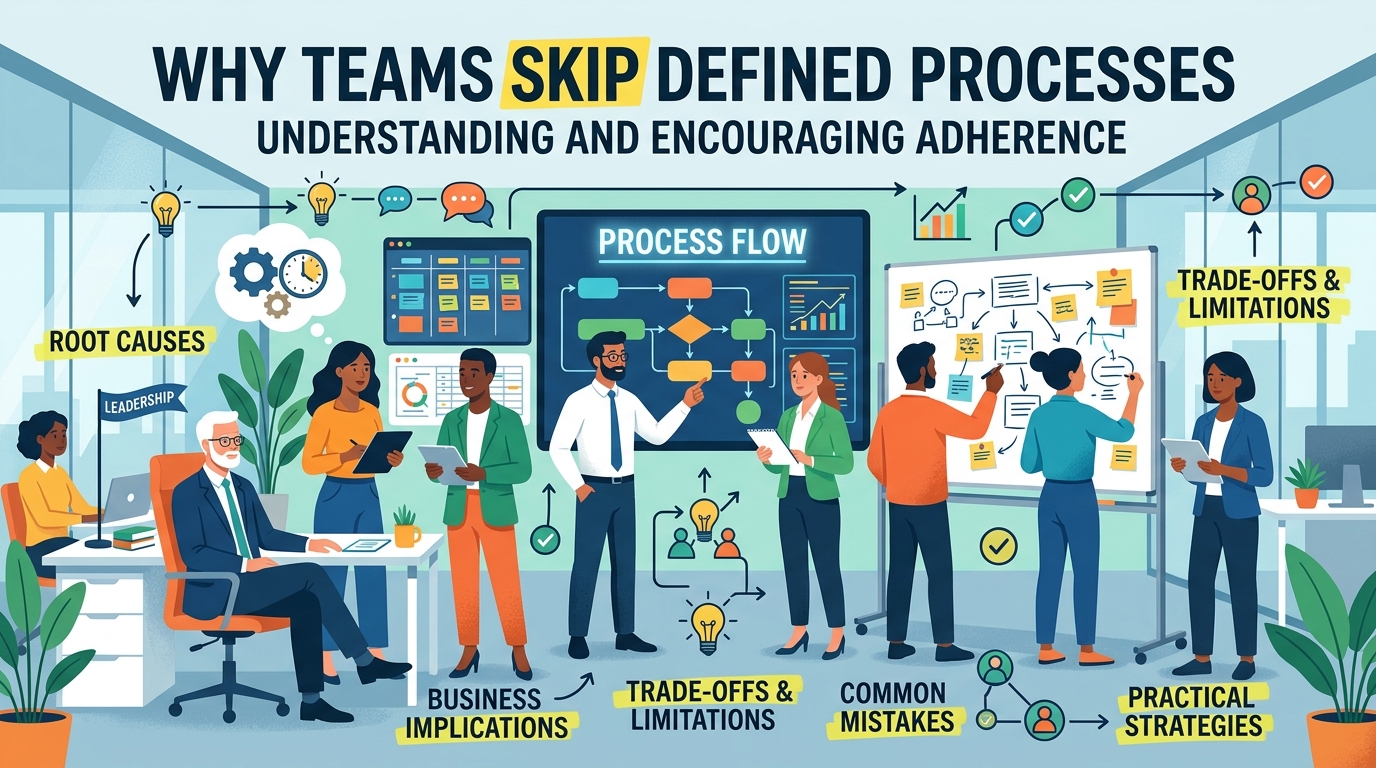
- Why Teams Skip Defined Processes
- Root Causes of Skipping Processes
- Business Implications of Skipping Processes
- Trade-offs and Limitations in Process Adherence
- Common Mistakes and Misconceptions
- Practical Strategies to Encourage Process Adherence
Why Teams Skip Defined Processes
Teams skip defined processes primarily because these processes are often seen as obstacles rather than enablers. According to the research, common factors include poor process design, lack of employee involvement, and inadequate communication. When processes are overly complex, outdated, or disconnected from frontline realities, employees tend to bypass them to complete tasks more quickly or efficiently (processexcellencenetwork.com).
Additional reasons include:
- Processes designed top-down without input from users, causing resistance and lack of ownership.
- Insufficient training and unclear communication about the purpose and benefits of the processes.
- Perception that following processes slows down work and adds unnecessary steps, especially under pressure.
- Weak leadership enforcement and accountability, signaling that adherence is optional.
For transportation businesses, such as those supported by Taxi Dispatching BPO Services, skipping processes can disrupt coordination and degrade customer experience, highlighting the importance of clear and practical workflows.
Root Causes of Skipping Processes
The root causes of skipping processes stem from a misalignment between process design and human behavior. Processes often fail because they create cognitive overload or do not align with the immediate goals of the workforce. Fear of change, lack of trust, and systemic inefficiencies also contribute significantly (processology.net).
Key root causes include:
- Overly complex or rigid processes that overwhelm employees and prompt shortcuts.
- Disconnect between management goals and frontline operational needs.
- Resistance due to fear of job insecurity or increased workload.
- Lack of transparency and dialogue about why processes are necessary.
- Legacy systems and data silos forcing manual workarounds.
Organizations in industries like ride-hailing benefit from specialized support such as Ride-Hailing BPO Services to bridge these gaps by integrating process design with practical execution and ongoing support.
Business Implications of Skipping Processes
Skipping defined processes has serious consequences for operational efficiency and risk management. It leads to increased costs, reduced productivity, inconsistent quality, and elevated compliance risks. These outcomes undermine business scalability and employee morale (navvia.com).
The implications include:
- Higher operational costs due to errors, rework, and wasted resources.
- Slower task completion and missed deadlines causing bottlenecks.
- Variable quality damaging customer satisfaction and brand reputation.
- Greater risk of regulatory breaches and security vulnerabilities.
- Difficulty in scaling operations and onboarding new employees.
- Lower employee engagement and higher turnover rates.
As companies grow, particularly in transportation sectors, maintaining strong process adherence is critical to sustaining service quality and operational consistency, as detailed in the Industries overview.
Trade-offs and Limitations in Process Adherence
There is often a gap between theoretically perfect processes and what works in practice. Processes that look good on paper may fail when human factors and operational realities are ignored. Overly complex documentation or rigid steps frequently lead to avoidance (primebpm.com).
Important trade-offs and variables include:
- Organizational culture's role in encouraging openness and continuous improvement.
- Task complexity necessitating flexible guidelines versus simple tasks benefiting from rigid processes.
- Leadership's visible commitment and enforcement of process adherence.
- Availability of adequate resources for training, tools, and process management.
When internal teams face limits due to expertise or capacity constraints, external partners like Fasttech BPO can provide objective process improvement and implementation support, especially for complex transport operations.
Common Mistakes and Misconceptions
Many organizations misattribute process non-adherence to employee attitudes alone, ignoring systemic issues. Common misconceptions include the belief that more process steps equal better control or that technology alone solves process challenges (activepieces.com).
Other frequent mistakes are:
- Assuming documentation alone ensures adherence without ongoing training and reinforcement.
- Viewing process implementation as a one-time project instead of an evolving initiative.
- Neglecting the human element and emotional impact of process changes.
Understanding these misconceptions is key to designing effective processes that employees will follow, particularly in customer-centric fields such as Limo Services BPO Services, where premium experience depends on consistent operational adherence.
Practical Strategies to Encourage Process Adherence
Encouraging teams to follow defined processes requires a human-centered approach emphasizing empathy, communication, and leadership engagement. Processes should be designed with input from the users and clearly communicate the benefits to foster ownership and motivation (processexcellencenetwork.com).
Effective strategies include:
- Involving frontline employees in process design and improvement discussions.
- Providing ongoing training and accessible, visual documentation.
- Establishing clear accountability and visible leadership commitment.
- Creating feedback loops for continuous process refinement.
- Aligning processes with real work conditions to reduce cognitive load and frustration.
Organizations operating in dynamic environments like taxi dispatching can benefit significantly from partnering with specialized BPO services that ensure process compliance and operational efficiency, as seen in Taxi Dispatching BPO Services.