
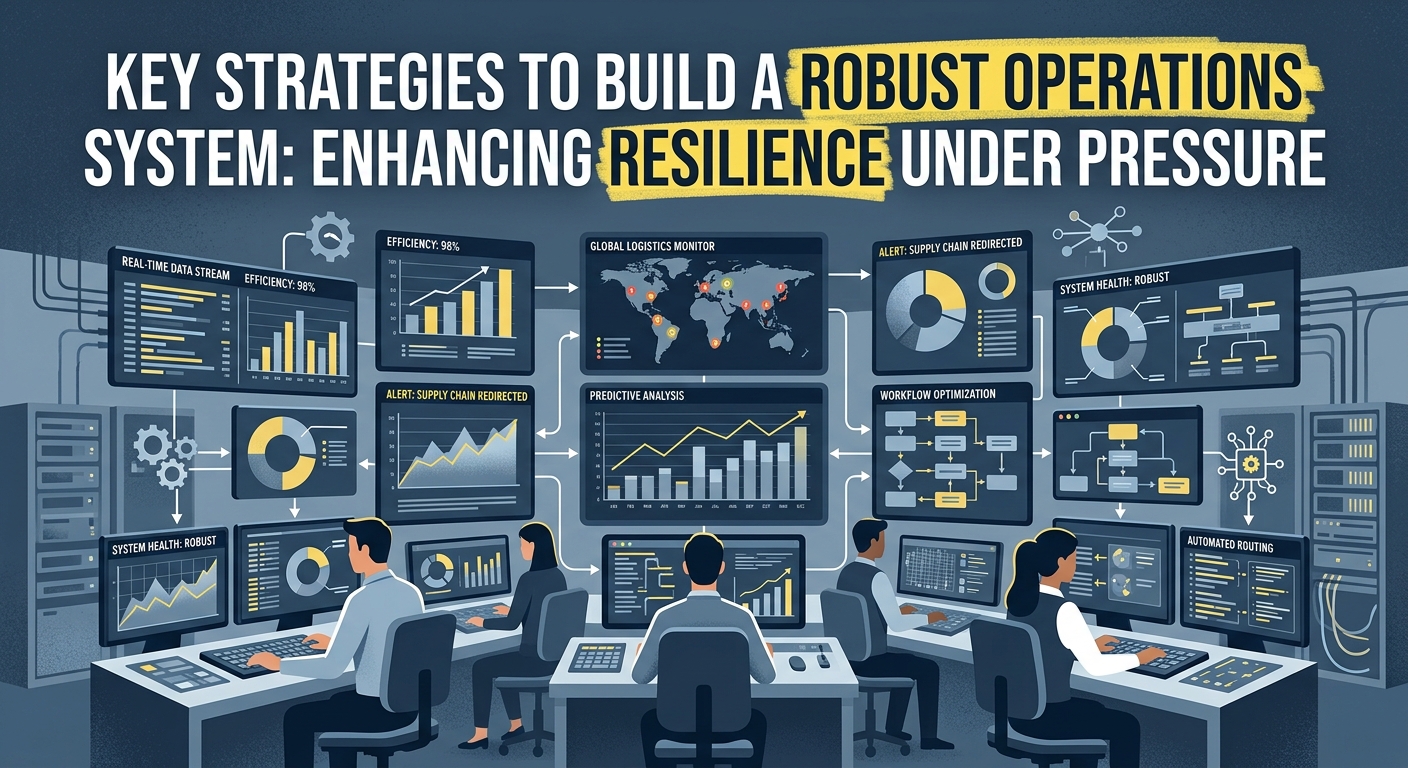
- What Defines a Robust Operations System?
- Key Characteristics of Effective Operations Systems
- Preparing Businesses for High-Pressure Situations
- Strategies to Build Resilient Operations Systems
- Balancing Efficiency and Resilience
- Common Pitfalls in Creating Pressure-Resistant Systems
- Practical Steps to Implement a Pressure-Resistant Operations System
What Defines a Robust Operations System?
A robust operations system is defined by its ability to maintain functionality and recover quickly under pressure. It is designed not just for efficiency during normal conditions but for resilience when faced with disruptions. According to research, effective systems prioritize proactive resilience through modular design, clear accountability, and continuous adaptation to absorb shocks and minimize disruption (Deep Research Report).
Such systems incorporate:
- Modularity and decoupling to isolate failures without cascading effects.
- Redundancy and diversification of critical resources and functions.
- Clear protocols combined with empowered autonomy to allow frontline decision-making.
For example, transportation operations benefit greatly from modular system components that allow independent scaling and failure isolation, which is why companies like Fasttech BPO emphasize modular designs in their transportation operations support.
Key Characteristics of Effective Operations Systems
Effective operations systems under pressure exhibit several key characteristics that enable resilience and adaptability. These include continuous monitoring, scenario planning, and human-centric design that balances automation with human oversight. Systems are built to learn and evolve from stress events rather than simply endure them (Deep Research Report).
Key features include:
- Continuous monitoring and feedback loops for real-time visibility and rapid improvement.
- Scenario planning and stress testing to identify weaknesses before live failures.
- Human-centric design that accounts for cognitive biases and supports operators.
These characteristics are essential in industries such as ride-hailing, where rapid changes and dynamic environments are the norm. Leveraging specialized ride-hailing BPO services can help businesses maintain operational integrity during peak demand and unexpected disruptions.
Preparing Businesses for High-Pressure Situations
Preparation for high-pressure situations requires deliberate design choices and investments in resilience. Businesses must avoid brittle systems optimized only for average loads and instead build anti-fragile structures that improve under stress. This includes decentralizing decision-making and investing in training and technology that supports rapid response (Deep Research Report).
Preparation strategies include:
- Decoupling interdependent processes to prevent cascading failures.
- Creating redundancy in critical functions and resources.
- Empowering frontline teams with authority and training to act autonomously.
For taxi dispatching operations, ensuring dispatch coordination and overflow support through scalable BPO services can be a critical preparation step to handle surges effectively, as outlined in Fasttech's taxi dispatching BPO services.
Strategies to Build Resilient Operations Systems
Building resilient operations systems involves a balance of modular design, clear protocols, and continuous adaptation. Systems must be designed for controlled failure and rapid recovery rather than just prevention. Empowering frontline decision-making while leveraging technology to automate predictable tasks is crucial for maintaining service levels under pressure (Deep Research Report).
Effective strategies include:
- Designing modular and loosely coupled system components.
- Developing clear standard operating procedures with flexibility for exceptions.
- Implementing continuous feedback and iterative process improvement.
These strategies are applicable across transportation sectors, including limo and executive transportation, where premium service levels are maintained through detailed reservation management and chauffeur coordination. Fasttech's limo services BPO offerings exemplify this approach.
Balancing Efficiency and Resilience
Balancing efficiency with resilience is a key challenge in creating operations systems that withstand pressure. While resilience requires redundancy and buffer capacity, these often come at the cost of increased operational expenses. The trade-off lies in identifying critical functions where resilience cannot be compromised and optimizing other areas for efficiency (Deep Research Report).
Considerations for balance include:
- Investing in redundancy only for mission-critical operations.
- Using automation for routine tasks while preserving human oversight for complex decisions.
- Maintaining standardized core processes with built-in agility for rapid adaptation.
Fasttech BPO's approach to scalable, 24/7 transportation operations support demonstrates how to manage this balance effectively, ensuring service continuity without excessive cost escalation (Fasttech BPO).
Common Pitfalls in Creating Pressure-Resistant Systems
Common mistakes in building pressure-resistant operations systems include over-reliance on additional resources without process improvements, ignoring peak load demands, and neglecting the human element. These pitfalls often lead to brittle systems that fail under stress (Deep Research Report).
Frequent pitfalls are:
- Throwing more people or tools at broken processes without clear protocols.
- Designing systems only for average loads, ignoring surges.
- Over-automation without sufficient human support.
- Lack of clear ownership and accountability during crises.
Understanding these pitfalls helps organizations avoid costly failures and improve operational resilience. For transportation companies, partnering with experienced BPO providers can mitigate these risks effectively.
Practical Steps to Implement a Pressure-Resistant Operations System
Implementing a pressure-resistant operations system involves designing for controlled failure and rapid recovery, empowering teams, and leveraging modular systems with continuous feedback. This approach enables organizations to navigate disruptions effectively and maintain service quality (Deep Research Report).
Practical implementation steps:
- Develop clear protocols with empowered frontline decision-making.
- Invest in modular system architecture and redundancy.
- Establish continuous monitoring and feedback loops for iterative improvement.
These steps are integral to the success of transportation-focused BPO services that support dynamic, high-pressure environments. Companies can benefit from expert partners like Fasttech BPO that specialize in scalable operations optimization and resilience across taxi, ride-hailing, and limo services.