
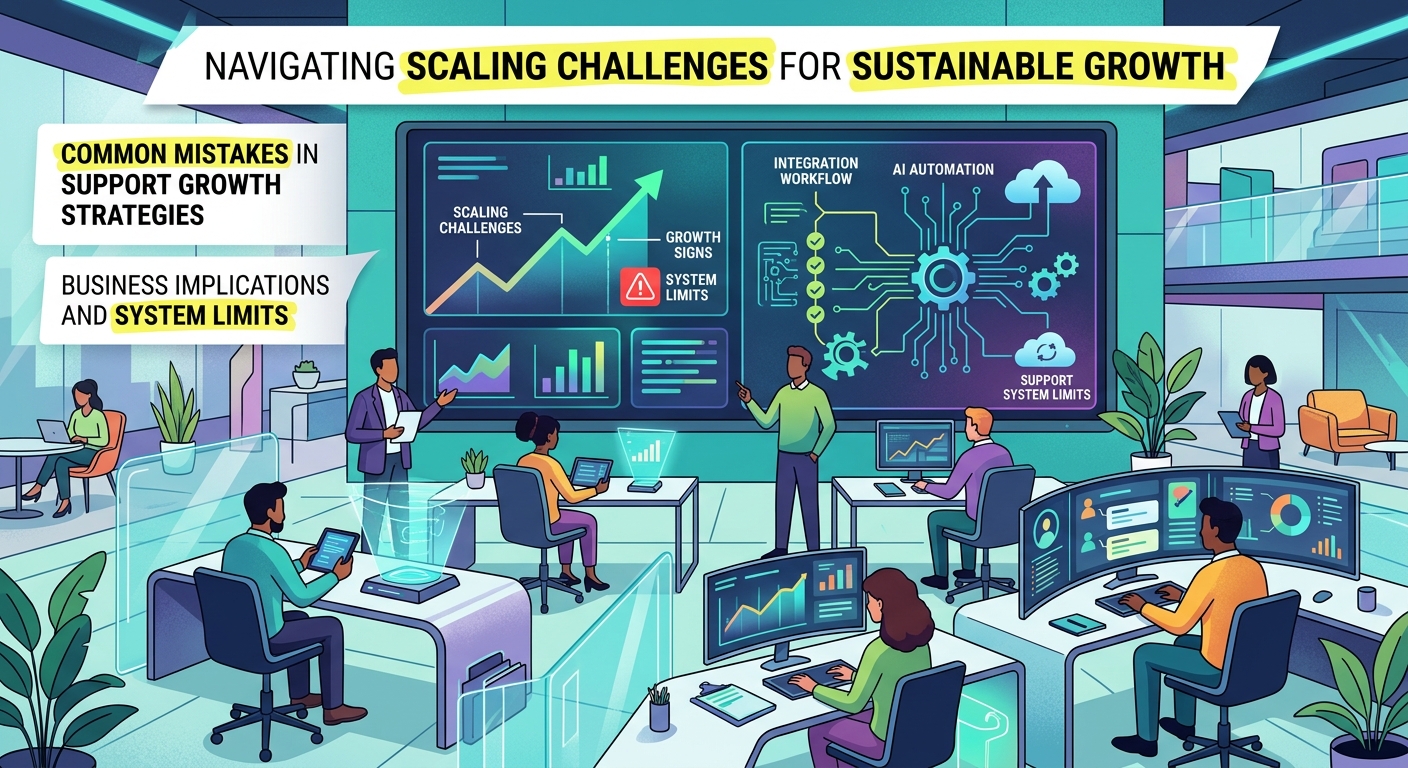
- Signs Your Current Support Setup Can’t Handle Growth
- Root Causes of Support System Limitations
- Business Implications of Inadequate Support Scaling
- Trade-offs in Scaling Customer Support
- Common Mistakes in Support Growth Strategies
- Adapting Your Support System for Sustainable Growth
Signs Your Current Support Setup Can’t Handle Growth
Your current customer support setup likely cannot handle growth if it relies heavily on linear headcount increases without strategic process improvements. According to research, businesses that only hire more agents to match growing inquiry volumes face diminishing returns and soaring costs, which ultimately erode service quality and efficiency (source: enshored.com).
Additional signs include inconsistent service quality, fragmented customer experiences across channels, and reactive problem-solving rather than proactive support. Key indicators to watch for include:
- Escalating operational costs that outpace revenue growth.
- Fragmented customer data across multiple disconnected systems.
- Burnout and high attrition rates among support agents due to workload pressure.
- Misaligned performance metrics favoring internal efficiency over customer satisfaction.
For example, in transportation businesses like taxi dispatching, these issues manifest as missed bookings and inconsistent driver communication, impacting customer retention and operational stability. Fasttech BPO provides specialized support solutions to address these challenges efficiently (Taxi dispatching BPO services).
Root Causes of Support System Limitations
The root causes of why support systems fail to scale effectively stem from outdated mindsets and organizational inertia. Many companies treat support as a cost center rather than a strategic asset, leading to resistance against redesigning workflows and investing in technology (source: fullstackoptimization.com).
Other contributing factors include:
- Short-term thinking focused on quick fixes like rapid hiring rather than long-term scalability.
- Lack of integration between customer data systems, causing information silos.
- Reactive operational models that prevent proactive issue resolution.
- Complex customer expectations requiring omnichannel, 24/7 support that traditional models cannot sustain.
- Ambiguity in process ownership and escalation paths.
These causes highlight the importance of adopting a data-driven, integrated support system that aligns with customer journey design and business growth strategies. Ride-hailing companies, for example, benefit from end-to-end support models that incorporate driver management and technical app support, as offered by Fasttech BPO (Ride-hailing BPO services).
Business Implications of Inadequate Support Scaling
Inadequate support scaling leads to significant negative business consequences, including escalating operational costs and increased customer churn. Research emphasizes that inefficient headcount scaling drives costs up while poor service quality harms revenue through lost customers (source: hirehoratio.com).
Other key business implications include:
- Damaged brand reputation and diminished trust among customers.
- Stalled innovation due to resource diversion toward reactive firefighting.
- Operational inefficiencies manifesting as bottlenecks and duplicated efforts.
These challenges underscore the need for scalable support systems that maintain service consistency and operational visibility. Companies in limo and executive transportation must safeguard their premium customer experience even during volume spikes, as detailed in the specialized support Fasttech BPO offers (Limo services BPO services).
Trade-offs in Scaling Customer Support
Scaling customer support involves balancing critical trade-offs between personalization, efficiency, automation, and customer satisfaction. While high-touch service ensures personalized customer interactions, it is resource-intensive and hard to scale. Conversely, automation improves efficiency but risks alienating customers if it lacks empathy or fails to address complex issues (source: customerexperiencedive.com).
Key trade-offs include:
- Personalized service versus scalability and cost control.
- Automation benefits versus the risk of impersonal customer experiences.
- Speed of response versus quality of resolution.
- Short-term cost reduction versus long-term operational debt.
Understanding these trade-offs helps businesses design support strategies that optimize resource allocation while preserving customer loyalty and satisfaction.
Common Mistakes in Support Growth Strategies
Common mistakes in scaling support include the misconception that hiring more agents alone solves capacity problems. This often neglects process inefficiencies and technology gaps, resulting in persistent overload and customer dissatisfaction (source: fullstackoptimization.com).
Other frequent errors are:
- Neglecting self-service options that reduce repetitive queries.
- Focusing solely on internal efficiency metrics like average handle time instead of customer-centric outcomes.
- Analysis paralysis that delays necessary system redesigns.
- Viewing support purely as a cost center rather than a growth driver.
Addressing these mistakes involves embracing support as a strategic asset and investing in scalable technology and workflows. Fasttech BPO's approach to managing support teams and workflows exemplifies this mindset (About Fasttech BPO).
Adapting Your Support System for Sustainable Growth
To handle growth effectively, organizations must redesign their support systems as integrated, data-driven, and technology-enabled rather than relying on reactive headcount increases. This shift prioritizes proactive issue resolution, intelligent automation, and agent empowerment (source: everworker.ai).
Key strategies include:
- Implementing unified customer data platforms to eliminate silos.
- Leveraging AI-driven chatbots and comprehensive knowledge bases for self-service support.
- Optimizing workflows to reduce redundant tasks and improve response quality.
- Aligning performance metrics with customer satisfaction and first-contact resolution.
- Partnering with specialized BPO providers to scale operations flexibly and cost-effectively.
For transportation companies, especially in ride-hailing and taxi dispatching, partnering with experts like Fasttech BPO enables scalable, consistent, and customer-centric support that grows with the business (Ride-hailing support, Taxi dispatching services).