
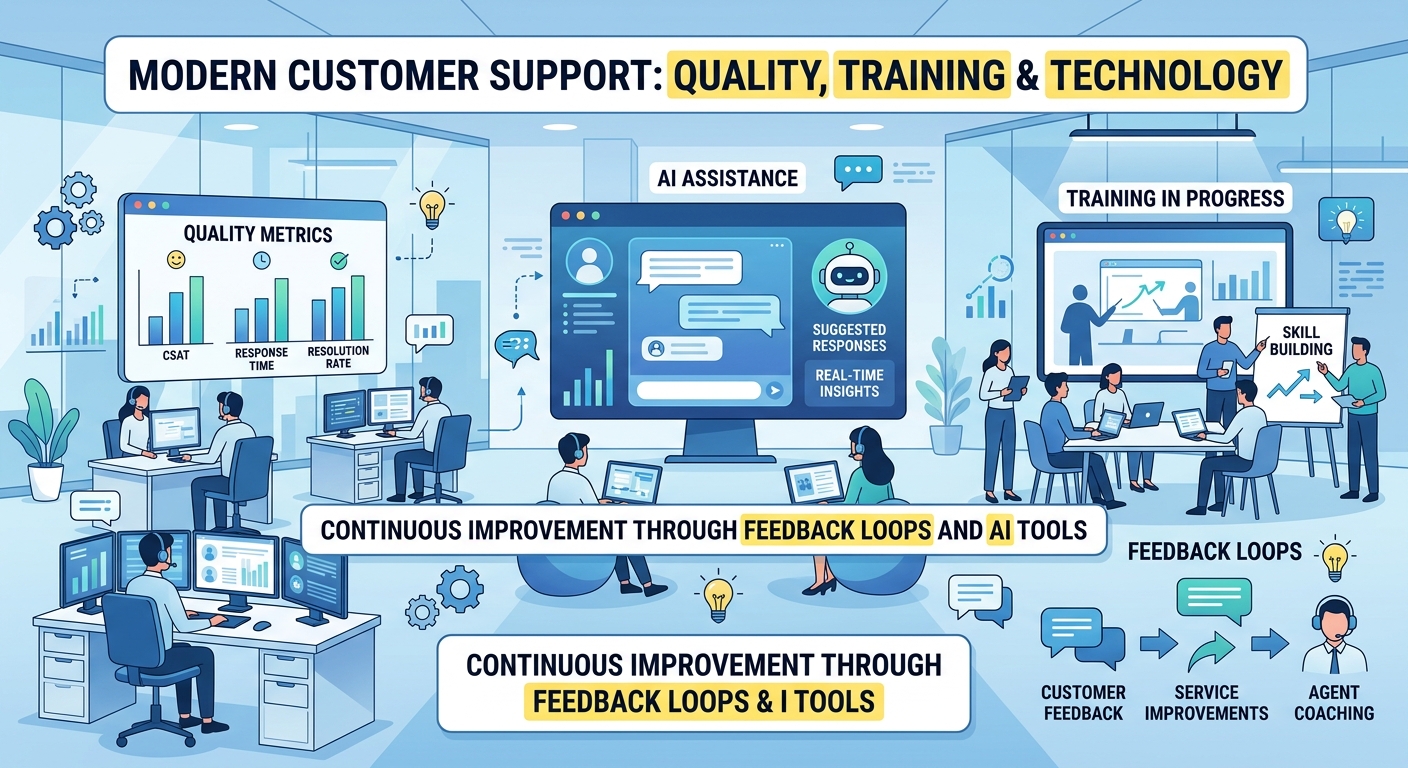
- Defining and Measuring Service Standards
- Continuous and Comprehensive Training for Support Teams
- Leveraging Technology for Quality and Consistency
- Implementing Robust Quality Assurance Frameworks
- Integrating Feedback Loops for Continuous Improvement
Defining and Measuring Service Standards
Ensuring consistent response quality in customer support begins with defining clear, measurable service standards. These standards set expectations for responsiveness, accuracy, tone, empathy, and resolution quality, providing a benchmark for all interactions. According to the research, "Consistently high-quality responses stem from clearly articulated standards that define responsiveness, accuracy, tone, empathy, and resolution quality across all channels." These standards must be specific and measurable through metrics to guide agents and evaluate performance effectively.
Building on this foundation, organizations should:
- Develop detailed service level agreements (SLAs) that outline response times and quality criteria.
- Establish key performance indicators (KPIs) such as first contact resolution (FCR), customer satisfaction (CSAT), and average handle time (AHT).
- Ensure standards apply uniformly across all customer support channels to maintain omnichannel consistency.
For example, a ride-hailing company might set a maximum response time for chat inquiries and require agents to use empathetic language, ensuring every customer interaction meets these criteria regardless of the communication channel. This approach aligns with maintaining a cohesive customer experience, a crucial factor highlighted for transportation industries like taxi dispatching and limo services, where consistent quality is paramount.
Continuous and Comprehensive Training for Support Teams
Continuous training is essential to maintain and improve response quality over time. The research emphasizes that "Initial onboarding and ongoing training are critical for equipping agents with product knowledge, communication skills, problem-solving techniques, empathy, and proficiency with support tools." Training must not be a one-time event but an evolving process that adapts to changes in products, customer expectations, and support technologies.
Key elements of effective training programs include:
- Regular refresher courses and workshops to update agents on new features and policies.
- Role-playing and scenario-based training to enhance problem-solving and empathy skills.
- Training on the use of customer support tools and automation technology.
For transportation-focused customer support teams, such as those supporting ride-hailing or limo services, specialized training ensures agents handle unique customer scenarios professionally and efficiently. Fasttech BPO’s expertise in these industries demonstrates the value of tailored training programs that address specific operational nuances and customer expectations.
Leveraging Technology for Quality and Consistency
Strategic adoption of technology is a key pillar in building a system that ensures consistent response quality. According to the report, leveraging tools such as CRM systems, knowledge bases, ticketing platforms, live chat, and AI-powered automation standardizes processes and empowers agents with the necessary context and resources.
Organizations should consider implementing:
- AI-powered chatbots and agent assist tools to handle repetitive queries and provide real-time support suggestions.
- Comprehensive knowledge management systems to ensure accurate and up-to-date information is readily available.
- Integrated ticketing and CRM systems to maintain context across interactions and channels.
These technologies not only improve efficiency but also help maintain a uniform tone and accuracy, critical for industries like taxi dispatching and ride-hailing, where rapid, reliable communication is essential. For companies seeking to scale their customer support operations, technology is indispensable to maintain quality without proportionally increasing headcount.
Implementing Robust Quality Assurance Frameworks
A robust quality assurance (QA) framework is vital to systematically evaluate support interactions against defined standards and identify areas for improvement. The research highlights that "A structured QA process is essential for evaluating interactions against defined standards, identifying performance gaps, and providing targeted coaching." Modern QA frameworks leverage monitoring, scoring, and trend analysis to maintain and enhance response quality.
Effective QA frameworks typically include:
- Regular sampling and review of customer interactions across all channels.
- Use of AI-driven QA tools to analyze 100% of interactions and provide objective insights.
- Coaching and feedback sessions focused on development rather than punishment.
By implementing these practices, organizations can detect systemic issues early and foster a culture of continuous improvement. This is especially important for businesses with high ticket volumes or complex service requirements, such as those in the limo services or ride-hailing sectors, where maintaining consistency directly impacts customer loyalty and brand reputation.
Integrating Feedback Loops for Continuous Improvement
Integrated feedback loops are crucial for sustaining and enhancing response quality over time. The research notes that "Establishing closed-loop feedback systems that gather insights from direct customer feedback (surveys, reviews), performance metrics, and internal QA is paramount." This feedback must be actively analyzed and used to drive actionable improvements.
Key practices for effective feedback loops include:
- Collecting and aggregating customer feedback from multiple sources and channels.
- Analyzing performance data alongside customer sentiment to identify gaps.
- Communicating improvements and changes back to customers and internal teams.
Such a system ensures that customer support evolves in alignment with customer expectations and operational realities. Businesses in transportation industries, including taxi dispatching and limo services, benefit significantly from these feedback mechanisms to maintain high service standards and adapt swiftly to market changes.
For more insights on optimizing support operations in transportation sectors, explore Fasttech BPO’s specialized services in ride-hailing support and taxi dispatching BPO.