
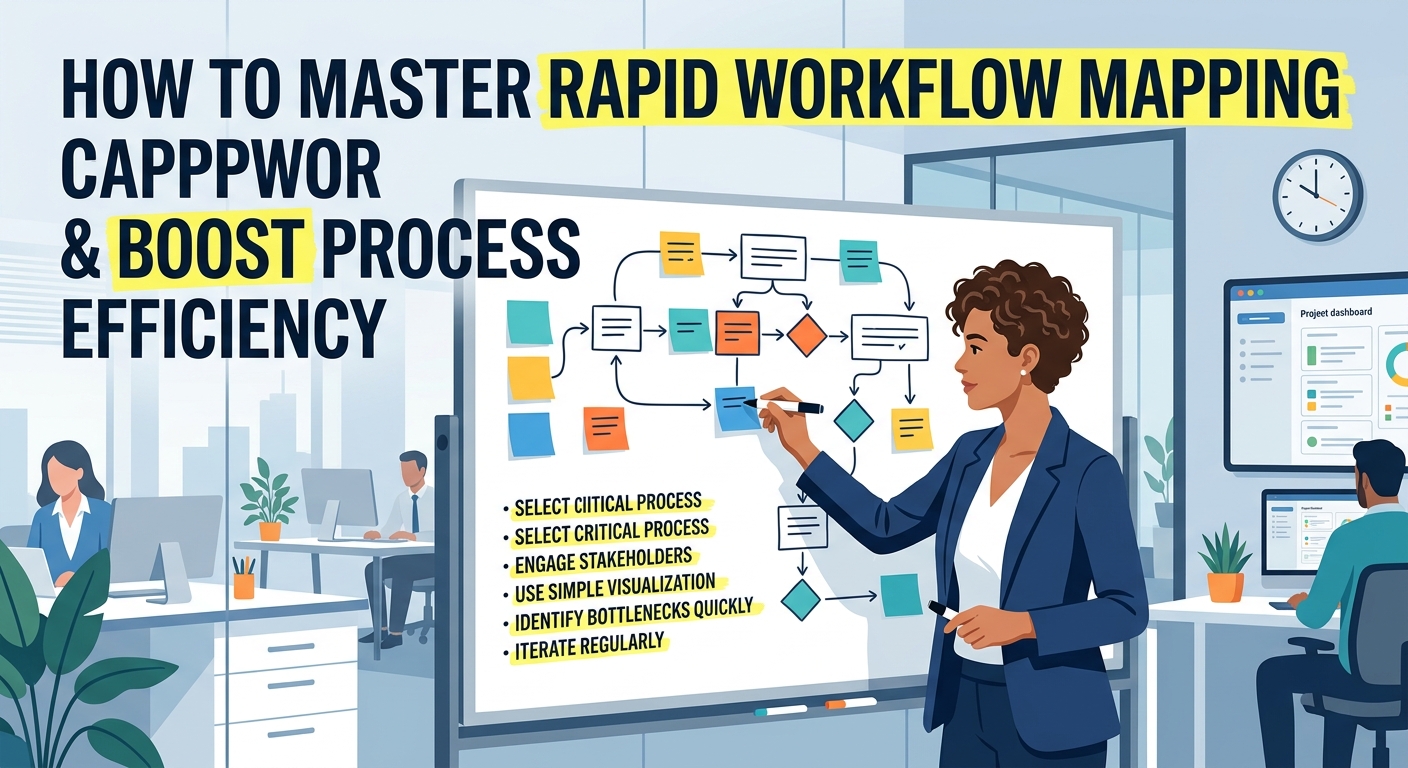
- Introduction to Rapid Workflow Mapping
- Step 1: Select a Critical Process
- Step 2: Engage Frontline Stakeholders
- Step 3: Use Simple Visualization Tools
- Step 4: Identify Bottlenecks Quickly
- Step 5: Iterate and Update Regularly
- Conclusion: Benefits of Rapid Workflow Mapping
Introduction to Rapid Workflow Mapping
Mapping a workflow in under 30 minutes is achievable by focusing on a high-level overview of one critical process and prioritizing input from those directly involved in the work. This approach emphasizes simplicity and speed to quickly visualize the "as-is" state of operations, enabling immediate identification of major inefficiencies and bottlenecks. According to research, rapid mapping aims to provide a decision-making lens for quick action rather than an exhaustive, detailed blueprint.[beebole.com]
Key patterns in successful rapid workflow mapping include simplicity, stakeholder engagement, and visual representation. These elements reduce cognitive load and provide clarity, which facilitates swift comprehension and action. The process is iterative and dynamic, ensuring maps stay relevant in evolving operational contexts.
For transportation-focused businesses, rapid workflow mapping is particularly useful for understanding critical processes like dispatch operations or driver onboarding. Engaging frontline teams through simple visual tools can reveal operational nuances missed by traditional documentation. This method aligns well with the services offered by Fasttech BPO, which specializes in taxi dispatching BPO services and ride-hailing support that rely on accurate, actionable process insights.
Step 1: Select a Critical Process
The first step in rapid workflow mapping is to choose one critical process that significantly impacts your operations. This focused scope prevents overwhelm and ensures the mapping exercise remains manageable within the 30-minute timeframe. The goal is to capture the core steps of this process to quickly expose major friction points and inefficiencies.[gravityflow.io]
When selecting the process, consider the following criteria:
- Processes with frequent delays or bottlenecks
- High-impact operations affecting customer satisfaction or revenue
- Tasks with repetitive manual effort or high error rates
For example, in transportation BPO contexts, prioritizing a process like dispatch coordination or driver onboarding can yield immediate operational improvements. Fasttech BPO's expertise in limo services BPO highlights how critical process focus drives premium service delivery.
Step 2: Engage Frontline Stakeholders
Direct involvement of frontline employees who perform the work is crucial to accurately map the real-world workflow. These individuals hold valuable tribal knowledge about informal steps, exceptions, and workarounds that are often absent from formal documentation. Research emphasizes that excluding frontline input leads to inaccurate maps that fail to reflect actual practice.[vibe.us]
Engagement tactics include:
- Conducting quick interviews or group sessions with operators
- Observing the process in action briefly
- Encouraging frontline staff to point out pain points and inefficiencies
This collaborative approach ensures the map reflects the "as-is" state, providing a solid foundation for identifying actionable improvements. Fasttech BPO's operational model thrives on such stakeholder engagement to optimize ride-hailing support and taxi dispatching services.
Step 3: Use Simple Visualization Tools
Utilizing simple visual tools like flowcharts, sticky notes, or swimlane diagrams enables quick and clear representation of the workflow. The research highlights that simplicity in visuals reduces cognitive load and makes the process understandable at a glance, which is essential for rapid mapping.[moxo.com]
Effective visualization tools for rapid mapping include:
- Basic flowchart software or templates
- Physical sticky notes on whiteboards or walls
- Online collaborative tools with drag-and-drop features
Modern tools with AI-powered auto-capture capabilities can accelerate the initial mapping phase, allowing teams to focus on validating and refining the workflow rather than spending excessive time on documentation. These tools support continuous updates, aligning with the dynamic nature of workflows.
Step 4: Identify Bottlenecks Quickly
The primary goal of rapid workflow mapping is to pinpoint major bottlenecks and inefficiencies that hinder operational performance. By visualizing the process, teams can immediately see where delays, redundancies, or rework occur.[redbricklabs.io]
Key focus areas for bottleneck identification include:
- Steps with long wait times or queues
- Manual handoffs prone to errors or delays
- Repetitive tasks that consume disproportionate time
Recognizing these bottlenecks allows organizations to prioritize improvement initiatives that deliver the most significant operational impact. For transportation BPO companies like Fasttech BPO, this insight is vital for enhancing dispatch efficiency and customer satisfaction.
Step 5: Iterate and Update Regularly
Workflow maps should be treated as living documents that evolve with changing business conditions. An iterative approach ensures the map remains accurate and continues to provide value over time. Research stresses the importance of continuous review, validation, and updates.[businessmapping.com]
Best practices for iteration include:
- Scheduling regular review sessions with stakeholders
- Incorporating feedback from process users and customers
- Updating the map to reflect process changes or improvements
This dynamic approach prevents the map from becoming obsolete and supports ongoing process optimization. Fasttech BPO's commitment to excellence includes maintaining adaptable workflows in its industries served, ensuring clients benefit from continuously optimized operations.
Conclusion: Benefits of Rapid Workflow Mapping
Rapid workflow mapping offers a practical, time-efficient way to gain immediate clarity on operational processes and identify key improvement opportunities. By focusing on simplicity, stakeholder engagement, and visual clarity, organizations can quickly uncover bottlenecks and take action to enhance efficiency.[creately.com]
This approach reduces initial resource investment, supports scalability by establishing a strong process foundation, and mitigates risks associated with inaccurate or outdated process documentation. Transportation businesses, especially those relying on real-time operations like ride-hailing and taxi dispatching, can leverage rapid workflow mapping to maintain high service standards and operational agility.
For companies looking to streamline their operations, partnering with specialized providers like Fasttech BPO can further accelerate process improvements and operational excellence through expert workflow management and execution support.