
- Understanding Key Person Dependency in Operations
- Root Causes of Over-Reliance on Specific Employees
- Business Implications of Dependency on Key Individuals
- Strategies to Build a Resilient and Scalable Team Structure
Understanding Key Person Dependency in Operations
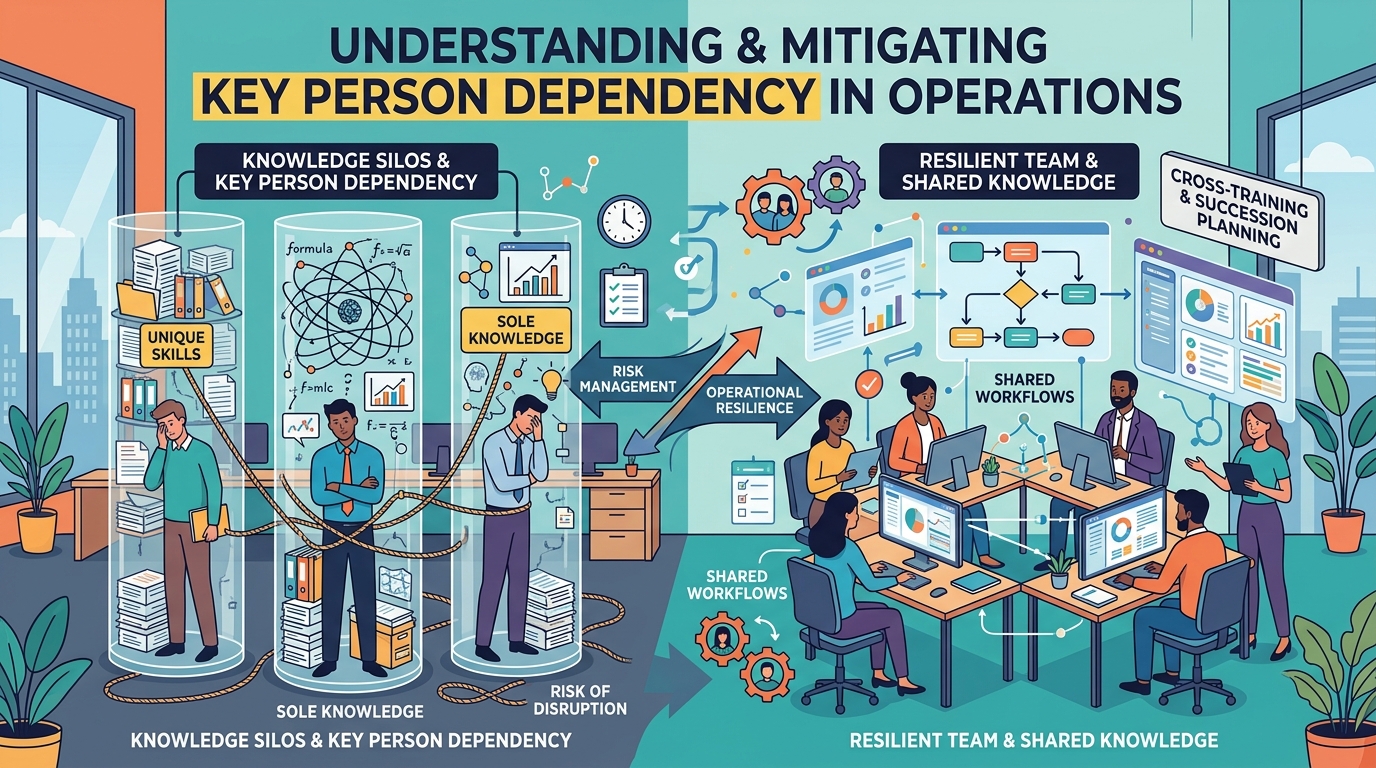
Key person dependency in operations arises when critical knowledge, skills, and relationships are concentrated in a few specific employees, creating structural vulnerabilities. This phenomenon often results in "knowledge silos" where essential operational information is not widely shared or documented, making the business fragile in the face of unexpected employee absence or turnover. As research highlights, this concentration stifles innovation and hampers business continuity, demanding a shift from reliance on individual heroics toward systemic resilience (workflawless.com).
Key aspects of this dependency include:
- Concentration of specialized skills and institutional memory in select employees.
- Undocumented workflows and processes that exist as tribal knowledge.
- Individual ownership of critical client or vendor relationships.
- A culture rewarding individual problem-solving over systemic solutions.
Such dependence limits scalability and increases operational risk, necessitating deliberate organizational strategies to disperse knowledge and responsibility.
Root Causes of Over-Reliance on Specific Employees
The root causes of over-reliance on specific employees often stem from organic growth patterns and short-term efficiency thinking. Organizations frequently evolve around high-performing individuals without intentional structural design, leading to ambiguous role definitions and undocumented processes. This creates an environment where knowledge and tasks accumulate in individuals rather than being institutionalized (monitask.com).
Additional factors driving this dependency include:
- Perceived immediate efficiency in relying on known experts rather than pausing to document and train others.
- Lack of proactive risk management acknowledging the "bus factor" risk.
- Underestimation of attrition costs and delayed investment in succession planning.
- Leadership blind spots mistaking dependency for strength.
Addressing these root causes requires cultural and operational shifts that prioritize long-term resilience over short-term expediency.
Business Implications of Dependency on Key Individuals
Dependency on key individuals poses significant risks to business continuity, financial stability, and growth potential. The sudden loss or unavailability of a critical employee can halt operations, delay projects, and degrade customer satisfaction. Financially, turnover costs including recruitment, training, and lost productivity can be substantial, sometimes reaching up to 400% of annual salary for key roles (verifiedmetrics.com).
Other notable implications include:
- Scalability bottlenecks limiting operational expansion.
- Reduced business valuation due to perceived operational immaturity.
- Innovation stifling as key individuals become gatekeepers.
- Increased employee burnout and decreased morale among both key and supporting staff.
These challenges highlight the critical need for systematic knowledge sharing and risk mitigation strategies to sustain healthy organizational growth and valuation.
Strategies to Build a Resilient and Scalable Team Structure
Building resilience in operations requires embedding knowledge capture, cross-training, and process documentation into everyday workflows. These systemic approaches transform individual expertise into institutional assets, mitigating risks associated with personnel changes. As noted, engaging external partners with specialized expertise can accelerate this transformation when internal capacity is limited (Fasttech BPO - Powering Transportation Operations).
Key strategies include:
- Developing and maintaining comprehensive Standard Operating Procedures (SOPs) to reduce tribal knowledge.
- Implementing formal cross-training programs to build redundancy in critical roles.
- Establishing clear succession planning to ensure smooth transitions.
- Encouraging a culture that values knowledge sharing over hero culture.
- Using technology and workflow tools to visualize and manage knowledge and processes effectively.
For transportation companies, specialized outsourcing services like those offered in taxi dispatching BPO services and ride-hailing support can provide scalable, resilient operational support that reduces dependency on individual employees while improving service quality and operational efficiency.