
- Critical Elements of a Well-Designed Support System
- Implementing Intelligent Automation and AI Integration
- Building Robust Self-Service Ecosystems
- Establishing Structured Tiered Support Models
- Creating a Unified Omnichannel Experience
- Leveraging Data-Driven Performance Optimization
- Streamlining Processes and Workflow Efficiency
- Strategic Outsourcing for Elastic Capacity
- Conclusion: Designing for Sustainable Support System Growth
Critical Elements of a Well-Designed Support System
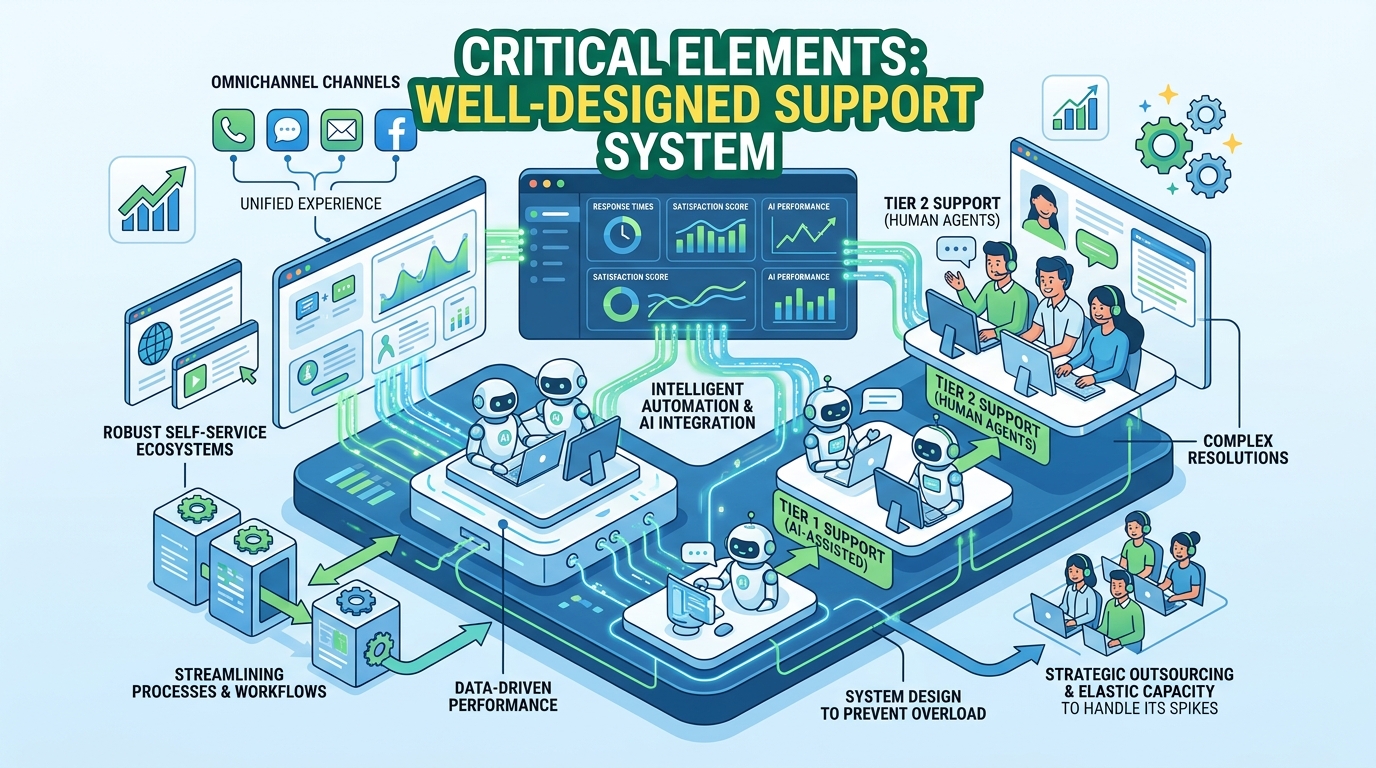
A well-designed support system to prevent overload integrates multiple strategic elements that collectively ensure sustainability and efficiency. Key components include intelligent automation, robust self-service options, tiered support structures, omnichannel communication, data-driven optimization, streamlined workflows, and strategic outsourcing. These elements work together to deflect volume, optimize resource allocation, and maintain service quality under increasing demand.
According to the research, organizations must move beyond linear headcount growth and embrace a strategic architectural shift that includes:
- Proactive customer engagement
- Self-service and AI-driven automation
- Tiered support models with clear escalation paths
- Unified omnichannel platforms
- Continuous data analysis for performance optimization
- Streamlined process and workflow standardization
- Elastic capacity through strategic outsourcing
This integrated approach addresses the root causes of overload such as agent burnout, fragmented systems, and unsustainable scaling, enabling businesses to meet evolving customer expectations efficiently.
Implementing Intelligent Automation and AI Integration
Intelligent automation and AI integration are critical in reducing the burden on human agents by automating repetitive tasks and handling Tier 0 inquiries. AI agents, chatbots, and virtual assistants provide 24/7 availability and intelligent ticket routing, which significantly improves response times and operational efficiency.
Key benefits of implementing intelligent automation include:
- Automating repetitive and low-complexity tasks
- Providing immediate responses to common inquiries
- Enabling intelligent ticket routing to the appropriate support tier
- Reducing operational costs and minimizing agent burnout
However, it is important to balance automation with human empathy, especially for complex or sensitive issues where a personal touch is essential to maintain customer satisfaction.
Building Robust Self-Service Ecosystems
Robust self-service ecosystems empower customers to resolve issues independently, thereby deflecting ticket volume from live agents. Comprehensive knowledge bases, FAQs, community forums, and in-product help are vital components of effective self-service support.
Successful self-service implementation requires:
- Well-organized and easily navigable content
- Clear pathways to escalate to human support when needed
- Continuous content optimization based on customer feedback and usage data
Although self-service can be up to eight times more cost-effective than live support channels, its effectiveness depends heavily on usability and relevance, with average success rates around 14% if not properly maintained.
Establishing Structured Tiered Support Models
Structured tiered support models allocate resources efficiently by categorizing issues based on complexity and expertise required. This model ensures that simple issues are resolved quickly at lower tiers, while complex problems receive attention from specialized teams.
Critical practices for tiered support include:
- Defining clear roles and responsibilities across support tiers
- Standardizing escalation paths to minimize handoff delays
- Maintaining robust internal knowledge sharing to support agent expertise
While tiered models improve resolution efficiency, excessive tiers or unclear procedures can introduce confusion and slow down issue resolution, so balance and clarity are essential.
Creating a Unified Omnichannel Experience
A unified omnichannel experience integrates all customer communication channels into a single system of record, providing agents with full context and ensuring consistent interactions. This integration is crucial to meet customers’ expectations for seamless support across phone, chat, email, and social media.
The benefits of an omnichannel platform include:
- Consistent and personalized customer interactions
- Improved agent efficiency with full customer history
- Reduced friction and duplication in issue handling
Implementing such systems requires investment in technology and careful process alignment but is essential for scalable, quality support delivery in modern environments like ride-hailing and taxi dispatching, where real-time responsiveness is paramount. Organizations providing ride-hailing support and taxi dispatching BPO services benefit greatly from unified omnichannel systems.
Leveraging Data-Driven Performance Optimization
Data-driven performance optimization involves continuously monitoring key support metrics such as First Contact Resolution (FCR), Average Handle Time (AHT), and Customer Satisfaction (CSAT) to identify bottlenecks and refine processes. This proactive approach enables organizations to anticipate demand and optimize resource allocation effectively.
Key aspects of this approach include:
- Tracking and analyzing support KPIs regularly
- Using data insights to inform process improvements
- Identifying trends to forecast workload and staffing needs
By leveraging these insights, support teams can reduce backlog, improve response times, and maintain high-quality service, turning support operations into strategic assets that drive growth.
Streamlining Processes and Workflow Efficiency
Streamlining processes and improving workflow efficiency are essential to minimize friction and accelerate issue resolution. Standardizing intake procedures, documenting workflows, defining clear ownership, and optimizing handoffs reduce delays and errors.
Effective strategies include:
- Creating clear process documentation and training programs
- Implementing standardized workflows with defined roles
- Optimizing handoff procedures to avoid information loss
- Eliminating non-value-adding activities and redundancies
These measures reduce agent frustration and support team burnout, enabling sustainable daily operations and consistent service quality.
Strategic Outsourcing for Elastic Capacity
Strategic outsourcing provides flexible staffing and specialized expertise to manage fluctuating demand without the costs and risks of linear headcount growth. Outsourcing partners can offer 24/7 coverage, surge support, and optimized operational risk management.
Benefits of outsourcing include:
- Elastic capacity to handle peak periods and volume spikes
- Access to specialized skills and technology platforms
- Cost savings compared to internal scaling
- Improved service continuity and compliance management
However, selecting the right partner is critical to mitigate risks related to data security, cultural alignment, and maintaining brand quality. For transportation-focused industries, Fasttech BPO offers tailored outsourcing solutions that align with industry-specific demands.
Conclusion: Designing for Sustainable Support System Growth
Designing a support system that prevents overload requires an integrated, multi-dimensional approach. Organizations must prioritize proactive self-service and intelligent automation to deflect volume, establish clear tiered support structures, unify communication channels, leverage data for continuous improvement, streamline workflows, and strategically outsource for capacity flexibility.
This holistic design shifts customer support from a reactive cost center to a scalable, strategic function that supports business growth and enhances customer satisfaction. Transportation companies, including those in limo services, benefit particularly from these innovations to maintain premium service quality without proportional increases in internal headcount.
For a deeper dive into optimizing support workflows and managing team capacity efficiently, explore related insights in our Insights hub.